Friday, March 11, 2011

Jewish Texts Lost in War Are Surfacing in New York

Lotte Strauss’s husband, Herbert, owned one of the books in the collection on the Science of Judaism.
by: Sam Dolnick

In 1932, as the Nazis rose to power in Germany, a Jewish librarian in Frankfurt published a catalog of 15,000 books he had painstakingly collected for decades.


It listed the key texts of a groundbreaking field called the Science of Judaism, in which scholars analyzed the religion’s philosophy and culture as they would study those of ancient Greece or Rome. The school of thought became the foundation for modern Jewish studies around the world.


In the tumult of war, great chunks of the collection vanished. Now, librarians an ocean away have determined that most of the missing titles have been sitting for years on the crowded shelves of the Leo Baeck Institute, a Manhattan center dedicated to preserving German Jewish culture.

The story of how the hundreds of tattered, cloth-bound books with esoteric German titles ended up in New York includes impossible escapes, careful scholarship and some very heavy suitcases. And while the exact trails of many of the volumes remain murky, they wind through book-lined apartments on the Upper West Side, across a 97-year-old woman’s cluttered coffee table and into a library’s cavernous stacks.

For Jewish scholars, the collection of Science of Judaism texts (in German, Wissenschaft des Judentums) is a touchstone marking the emergence of Jewish tradition as a philosophy and culture worthy of academic study.

“We’re all heirs to the legacy of Wissenschaft,” said Jonathan D. Sarna, a professor of American Jewish history at Brandeis University.

The University Library Frankfurt still houses the bulk of the collection, but experts there have determined over several decades that they were missing some 2,000 books listed in the 1932 catalog. In the last two years, a team led by Renate Evers, head librarian at the Leo Baeck Institute, found that her shelves had more than 1,000 of the lost titles.

While scholars say the books in New York are probably not the same copies as those lost from the Frankfurt library, their rediscovery offers the chance to rebuild what one professor called “a legendary collection.” Frankfurt librarians are putting the collection online, while the Center for Jewish History, the institute’s parent organization, is seeking a grant to do the same.

“This is very exciting,” said Rachel Heuberger, head of the library’s Judaica division. “You can reconstruct a collection that otherwise never would have come to life again.”

Scholars say the books were most likely brought to New York from Europe by private collectors and antiquities dealers. In the past 50 years, donors, nearly all of them German Jews who immigrated and prospered here, gave them to the Leo Baeck Institute.

The donors, photographed in their cinched ties and sober suits, represent a generation of scholarly New York immigrants that is nearly gone. They escaped the Nazis, built new lives and created a sophisticated community that centered on books, culture and learning. Their ranks included the political philosopher Hannah Arendt and Dr. Ruth Westheimer.

Many came to this country hauling suitcases filled with books, and as they settled here, they created academic journals and scholarly institutes. They debated politics during formal dinners in Washington Heights parlors. They took typewriters along on vacation so they could keep working.

Herbert A. Strauss, who came to New York with his wife in 1946, owned one of the lost books, an 1843 volume by Ludwig Philippson. Where he got it, his widow, Lotte, has no idea. A historian and a professor, he was always coming home to their Upper Manhattan apartment with his arms full of new tomes.

“He was not only married to me,” Mrs. Strauss said. “He was also married to his desk.”

When he died in 2005, she donated 4,500 of his books to the Leo Baeck Institute.

The couple had met in Germany, and escaped together to Switzerland just steps ahead of the Gestapo. They recounted their ordeals in separate memoirs published in 1999.

Mrs. Strauss, 97, a great-grandmother, recalled meeting her husband. “I was fascinated by him,” she said. “He was good-looking and he had new ideas.”

On a recent afternoon in her sun-drenched apartment, Mrs. Strauss pulled out her husband’s brittle papers. There were Nazi-era ration cards decorated with swastikas — red for bread, blue for meat. There was a lifeguard certificate from Berlin that showed a young man, sleeves rolled up past his elbows, smiling at something off-camera.

Did he carry books with him when he came to New York?

Mrs. Strauss laughed. “We came here poor as church mice,” she said. “You went as you were; you didn’t carry a thing.” She was eight months pregnant and had one dress to her name. Mr. Strauss built his library, and their life, in New York.

Ludwig Schwarzschild, a dermatologist, brought his library with him when he came to the United States in 1934. Although his practice north of Frankfurt was shuttered by the authorities, he, his wife and their two young children were able to take most of their possessions out of Germany, said their daughter, Lore Singerman, of Annapolis, Md.

Mrs. Singerman, 78, remembered a Manhattan childhood of heavy European furniture and crowded bookcases. Reading was highly prized — prayer books, The Saturday Evening Post, National Geographic.

Her father owned one of the lost Wissenschaft volumes, an 1888 edition of a Hermann Cohen book. His family donated it to the institute in 1970, the year he died. Mrs. Singerman does not know where her father got the book, but said, “If it was in German, he probably brought it with him — he didn’t buy German books here.”

Fred W. Lessing, another German Jewish donor, built such a vast book collection at his home in Scarsdale, N.Y., that he ordered catalog cards from the Library of Congress to keep track of it all. He was chief executive of a Yonkers metal company, but his passion was his library and discussions with professors and writers.

Mr. Lessing scoured auction catalogs for treasures, with a special focus on the history of the Enlightenment. His children knew enough not to touch his “good books,” said his daughter Joan Lessing. “His library was part of our lives,” she said. “Books were in every room.”

Mr. Lessing gave the institute an early-20th-century edition of a volume by Adolf Eckstein, but his daughter did not know where he had gotten it.

Even the Frankfurt librarian who cataloged the entire collection, Aron Freimann, came to New York. After arriving in 1939, he went on to work at the New York Public Library.

Today, his granddaughter, Ruth Dresner, lives in the Riverdale section of the Bronx. She keeps her grandfather’s catalog on her shelf — she calls it his “magnum opus” — and plans to leave it to her children.

“I’m 80 years old, and I’m very devoted and dedicated to perpetuating tradition,” she said. “I am very proud.”

This article has been revised to reflect the following correction:

Correction: March 9, 2011

A caption on Tuesday with an article about Jewish texts lost in World War II that have resurfaced in New York described an accompanying map incorrectly. It is a map of central Europe, not only of Frankfurt.


from: NY Times

Thursday, March 10, 2011

Country music star Dolly Parton in Scots book giveaway

Country music star Dolly Parton has launched a project to give free books to children in Scotland.


The Imagination Library scheme will see youngsters in care given a free book every month until their fifth birthday.


The initiative, which is being run in partnership with the Scottish government and the Scottish Book Trust, will involve about 3,341 children.

The Dollywood Foundation project has already proved successful in the US and other parts of the UK.

Dolly Parton developed the project in 1995 for her hometown of Sevier County in Tennessee.
It proved so successful that neighbouring communities asked to join, before it spread across the US.

The project began in the UK in Rotherham in December 2007 and has grown to operate in a dozen areas.

However, the Scottish project is the first to run on a national basis, purely for children in care.

'Language skills'

Dolly Parton said: "I am thrilled to be a part of this wonderful effort. When I started the Imagination Library in my hometown, I never dreamed that one day we would be helping Scottish kids”

"Much of my music has been inspired by Scotland so it's only right that we are now in a position to bring more joy into the lives of the nation's looked after children.

"From the bottom of my country heart, I want to thank the Scottish government and the Scottish Book Trust for asking us to be part of something so special."

Children's Minister Adam Ingram said the scheme aimed to ensure looked after children were given some of the same life chances as others.

He added: "Research also shows that children whose parents and carers talk to them frequently have better language skills than those who do not and that the presence of books in the home can have an important impact on long-term achievement."

The books for the Imagination Library programme will be selected by a committee of experts in the field of childhood development, literacy and education, with a Scottish expert set to join the panel later this year.


from: BBC

Wednesday, March 9, 2011

Ssshhh! The noisy US revolution coming to British libraries

by: Kunal Datta

Public libraries could be set for a radical overhaul that could see books offered alongside coffee, murder mystery nights, poetry evenings and open mic sessions, should the plans of a private US company be given the green light. Library Systems & Services, a Maryland-based firm, owns 13 public libraries in the US. Its aim in Britain is to manage 15 per cent of public libraries within the next five years.


LSSI is in consultation with local authorities across the UK, proposing to transform libraries into "multifunctional spaces". It hopes to have won contracts in at least four local authorities by the end of the year.

The company's entry to the UK is being managed by Stuart Fitzgerald and Jim Lynch, former inspectors for the Audit Commission. "There is an inefficiency that has crept into library services," Mr Fitzgerald says. "It's wrong. And it's not how public money should be spent."

LSSI's entry into the UK could also mark the start of a fierce transatlantic bidding war. Its main UK rival is John Laing, which manages libraries in Hounslow. The two have already competed head-to-head in a number of tenders, including the £10m contract for Slough's libraries which was eventually awarded to Essex Council last year.

The revenue model will differ for each council, although LSSI claims it can run public libraries at a fraction of the cost of local authorities.

The "slacks and trainers mentality" among librarians will be abolished, Mr Lynch says. In its place will be "a rigorous service culture".

Mr Fitzgerald adds: "We will work with local partners: the health services, the police, the fire service and business to get their messages across. Those agencies will pay to keep the library building open, people will come in to get books and at the same time these events will be happening in the libraries with these agencies as our partners."

But it might not be a smooth transition. In California two lawsuits have been filed to block local authorities from withdrawing from the state system and outsourcing to LSSI. Roberta Stevens, the president of the American Library Association, warns: "One of the biggest risks is the long-term nature of these contracts and their lack of transparency, particularly for librarians. Local authorities have to be absolutely clear on long-term commitments before signing these deals."

Peter Allenson, Unite's national organiser for local government, said: "The prospect of libraries being taken over by private companies, which will invariably be seeking to make profits, will lead to a much diminished service for the millions of people that use libraries in the UK."

Mr Fitzgerald insists that book borrowing will remain free, while peripheral services, such as coffee shops, IT centres and bookshops, could be added. "This is not selling off the crown jewels," he says. "It is about putting the library in the hands of experts who will remain answerable to the council at all times."

from: Independent

Tuesday, March 8, 2011

The dogs who listen to children reading

Scheme aims to encourage children to read aloud

by: Patrick Barkham

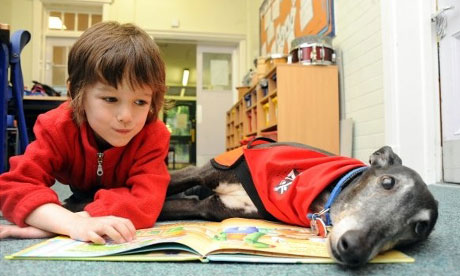
Some children show the dog the pictures as they read
When children read to him, Danny does not criticise or correct their pronunciation. He just nods and pricks up an ear, although sometimes he closes his eyes and appears not to be listening.


Danny is a greyhound and a novel way of encouraging pupils at Oakhill primary school in Tamworth, Staffordshire, to read aloud. A "listening dog", he is part of a scheme that originated in the US called Reading Education Assistance Dogs (Read).

"It helps with their self-esteem in reading out loud because he is non-judgmental," says the dog's owner, Tony Nevett, who has a degree in animal-assisted therapy. "He doesn't judge them and he doesn't laugh at them. He's just a tool – the children don't realise they are reading, which they might not have the confidence to do in class." Some children even show Danny the pictures as they read.

Danny received five months of training to become a Read dog. Greyhounds are particularly well-suited because they do not bark and their short coat is less likely to trigger allergies.

Nevett hopes that the scheme, piloted in Kent, will spread. "We've had some success stories, including a girl with Down's Syndrome who really took to the dog and improved her reading," he says. "When Danny goes to sleep I tell the children that he's dreaming about their story."


from: Guardian

Monday, March 7, 2011

Banned books return to shelves in Egypt and Tunisia

by: Benedicte Page

Old books market in Cairo. Photograph: Alamy
A number of highly political titles censored by the regime of ousted Tunisian president Zine al-Abidine Ben Ali are now returning to the country's bookshop shelves.

La Regente de Carthage by Nicolas Beau and Catherine Graciet, a critical book about the former president's family, focusing in particular on the role of his wife, Leila, is among those now openly on sale in the country, according to the International Publishers Association.

Alongside it is a previously banned study of the long-serving Tunisian president from whom Ben Ali took over following a 1987 coup: Habib Bourguiba: La Trace et l'Heritage by Michel Camau and Vincent Geisser.

Also now appearing in the country's bookshops are The Assassination of Salah Ben Youssef by Omar Khlifi, a book about the shooting of a former Tunisian minister of justice in Frankfurt in 1961, and works by journalist Toaufik Ben Brik, a prominent critic of Ben Ali's presidency.

Alexis Krikorian, director of the Freedom to Publish programme at the IPA, said the emergence of these and other formerly banned books within Tunisia was "very good news". Whether censorship still existed with regard to new titles was a separate issue, he added, but it was likely that the legal submission procedure, which under the old regime had been misused to block books at their printers, "no longer applies".

Anecdotal reports are also emerging of once suppressed titles appearing for impromptu sale on street corners and newspaper kiosks across Egypt. Salwa Gaspard of joint English/Arabic language publisher Saqi Books said accounts in the Arabic press told of books that had been hidden for years in private basements now once more seeing the light of day.

Cairo is also to hold a book fair in Tahrir Square – the focus for protests against former president Hosni Mubarak – at the end of March, according to Trevor Naylor of the American University of Cairo Press bookshop, which is based in the square. Naylor told the Bookseller that the event had been planned in the wake of the cancelled Cairo Book Fair, which was abandoned in January in the face of growing political unrest.

"Everyone around the globe now associates Tahrir Square with freedom and revolution," Naylor said. "We really wanted to do something that celebrates what happened here, and this seems like a great way to do it."

from: Guardian

Sunday, March 6, 2011

Artist turns old books into sculptures

American artist Brian Dettmer carves amazing sculptures from discarded books

by: Max Benato

Artist Brian Dettmer sculpts books into works of art, such as this The Household Physicians. Photograph: Brian Dettmer

Oh what to do with those out-of-date annuals, encyclopaedias, and other wieghty tomes. While some books beg to be passed on and shared, or even cherished selfishly through the centuries, some just don't stand the test of time.


Which is where a little book surgery comes in handy. American Brian Dettmer is one of a growing number of artists who has made a virtue of the redundant book by transforming it into a modern masterpiece.

He begins by sealing the edges of the book, then cuts into the surface and dissects it from the front using a range of tools that includes knives, tweezers and surgical tools.

There's no rushing it though – each page is painstakingly sculpted one at a time. And he never adds anything to the books, but only takes away.

Do try this at home.

from: Guardian

Saturday, March 5, 2011

On Murder & Montreal


by: Nathalie Atkinson

In between bottles of Dow and Molson’s, and often on an empty stomach, private investigator Russell Teed drinks a lot of Canadian rye. Enough that Bob and Doug McKenzie would be proud. Teed, a Westmount heir, not a heavy, isn’t exactly hardboiled but he’s street-savvy — the gumshoe equivalent of a forensic accountant.

Working from his cramped office in the CanAm building on Montreal’s Dominion Square, Teed is the creation of Charles Ross Graham, writing as David Montrose. The first two Montrose books appeared in 1951 and 1952 as part of Collins’ White Circle pocket books series (of which there were several hundred similar crime novels). They disappeared just as quickly: scarcely a copy can be found in any library in Canada.

Montreal-based Véhicule Press has been around since 1973, “and for over 25 years now, even longer,” says publisher Simon Dardick, “I’ve wanted to publish these books.” He’s collected several copies of Montrose’s four novels from secondhand bookshops over the years. “Then I’d look at some of the racism in it and think I can’t do it. Until I realized that it’s like taking the N-words out of Mark Twain: we put our little [publisher’s note] at the beginning instead — because I think they’re really valuable documents.”

Finally, Véhicule Press reissued The Crime on Cote des Neiges and Murder Over Dorval — the first two — last fall in a new reprint series called Ricochet (a nice bilingual touch). “It took a few beers to figure that one out,” he laughs. The covers are souped-up versions of the original art. It’s a small niche, Dardick admits, but sales on the 1,200 initial print run of the first two titles have been moderate; “there seems to be an appetite for it,” which means they’ll be adding titles to Ricochet. Montrose’s third Teed novel, The Body on Mount Royal, will come out next spring, with a contemporary artist designing a new cover in the pulp style.

“It’s a lovely antidote,” says Dardick, “to a lot of serious literary stuff we publish — it deserves to be looked at, and given some respect. To me, for Canadians, this is an interesting part of our history — our literary history, and our social history.”

Montrose’s prose can sometimes be a bit purple, in that Mickey Spillane way. Take Teed’s description of a femme fatale: “Her lower lip was more sensual than a Renaissance Venus. An archbishop would want to kiss that lower lip, would want to bite it until he drew blood.” But it’s also surprisingly good — more Dashiell Hammett than Spillane. When Teed pays a visit to a well-appointed modern apartment on Peel, “It looked just beautiful. It looked like a $10,000 cheque to an interior decorator.”

That they’re set in Montreal’s jazz and sometimes-seedy cabaret 1950s heyday is all the better — Teed plays all-night card games on Jeanne-Mance near Sherbrooke and goes on recce to remote cabins (just substitute the Laurentian Highway for Sam Spade’s Bay Area roads).

“Montreal becomes a character in the city,” Dardick says. “Decarie Boulevard, which is such a downmarket street now because of the recessed highway that goes right through the middle of it, used to be, as Montrose refers to it, the place to go to be seen.”

“I love the idea that they’re situated in Montreal, but we didn’t want to put Montreal in the name of the imprint,” he adds, “because if I can find something good that focuses on Winnipeg or Toronto, there are gems out there and it does interest me to reprint them whenever we can.”

Véhicule is also looking into rights for Ronald J. Cooke’s The Mayor of Cote St-Paul, first published in 1950, and The House of Craig Street (although the street’s name has since been changed to Viger).

Dardick is also intrigued by Brian Moore, the multiple Governor General’s Award winner for fiction and Booker-prize nominee. He explains that Moore seldom acknowledged his early writing of genre thrillers such as The Executioners. “He never wanted it to be known and what I’ve heard is he just disavowed them, because back in those days you didn’t write this type of book.”

A lot like Graham. “I think that Graham worked for a chemical company and middle management, it was just not done,” Dardick says. “I’ve always wondered whether he lived in Montrose Avenue in Westmount and that was his way of choosing a pseudonym.”

Meanwhile, Véhicule is still actively searching for the rights owners, since Graham a.k.a. Montrose died in 1967 (although the novels will become public domain in a few years). The foreword to the first book offers all that is known about Graham: that he was born in New Brunswick, lived in Nova Scotia and was an economist and chemical analyst with a penchant for crime writing. He was married twice, and he wrote four novels.

After that, the trail goes cold.

EXCERPT

“Dawn had done it. Looking from the edge of the bluff, all Montreal was spread below, from the rich stone mansions on Redpath Crescent at the top of town, to the turrets of the Chateau Apartments on Sherbrooke, to the narrow busy million-signed crampedness of St. Catherine, to the railroad tracks, St. Henri’s squalor, the canal, Verdun, the river. The St. Lawrence river, winding up here from the Atlantic to bring ocean ships farther inland than anywhere else in the world.

A mighty city. A mighty city for the Sark to live on like a maggot on a piece of rich fat meat. I wasn’t too sorry he was dead.” – From The Crime on Cote des Neiges by David Montrose (Véhicule Press)

OTHER PULP REPRINTS

True pulps aren’t paperbacks but earlier magazines printed on cheap pulp paper, which flourished domestically in Canada after the 1940 War Exchange Conservation Act by William Lyon Mackenzie King’s government. The influential writer Frank L. Packard, who during the Canadian pulp era created a character named Jimmie Dale, (also known as The Gray Seal), a template that later inspired Walter Gibson’s The Shadow. The pocket books sometimes called pulp, with artsy outrageous covers that came out in the 1940s and 1950s were for commuters to lug and slip into their pockets.

“We don’t deal generally in Canadian pulp material,” says dealer Neil Mechem of Girasol Collectibles in Mississauga. “It’s not generally collectible and Canadian material is not widely collected.” Mechem makes the rounds of the key spring pulp shows: the Fantastic Pulp Show & Sale in May in Toronto and the ones in Chicago (Windy City) and Ohio (Pulpfest), where does find that in addition to readers of pulp, “we’re seeing people coming into it for the nostalgic and historical value of it as pop culture is concerned.” It’s enough that Girasol has a niche pulp replica series – a complete facsimile reprint of whole magazines, even assembled in the same fashion, with a staple, and a Spider line of trade paperback series that re-sets text alongside original illustrations.

“It’s like anything else in quantity,” Mechem adds. “There’s the good the bad and the ugly. There is a lot of hack writing there’s a lot of that but there’s that in every genre.”

Tony Davis, a Toronto pulp aficionado and editor of the annual The Pulpster, recently went to the National Archives in Ottawa to check out the collection for a book he’s working on. Library & Archives Canada has made their “Tales from the Vault!” collection of Canadian pulp fiction (from 1940-1952) available for research, and online. Davis finds most of the Canadian-authored pulps at American shows. “I tend to find more from American vendors than I do from Canadian. The Americans usually say oh, it’s Canadian.” And lucky for Davis, accordingly they’re priced cheaply.

from: National Post