Friday, March 17, 2017

Metro.co.uk: Why this fashion brand is encouraging men to read more books by women

Why this fashion brand is encouraging men to read more books by women
By Ellen Scott

As John Waters once said: ‘If you go home with somebody and they don’t have books, don’t f*** ’em.’

Truer words have never been spoken.

But personally, I’d like to add an addendum to that rule: if they don’t have any books written by women, don’t f*** ’em either.

In an age in which there is so much brilliant literature written by women, it’s unforgivable for anyone to exclusively be reading men.

Why this fashion brand is encouraging men to read more books by women
(Picture: Sophie Davidson for Birdsong)

Not just because they’re missing out on all the amazing books written by women, but because they’re blinding themselves to a different perspective, only seeing the world through the eyes of men.

Which is a massive bloody shame.

Fashion brand Birdsong wants to change things.

Why this fashion brand is encouraging men to read more books by women
(Picture: Sophie Davidson for Birdsong)

They’ve just launched a campaign to get more men reading more books by women, creating a handy reading list for all men who only read books written by other dudes.

Boys With Books was inspired by a situation anyone who’s ever been on a dating app has likely experienced: seeing man after man listing off the same male authors as their favourites. ‘The lack of female authors was astounding,‘ wrote Sophie Davidson for Birdsong’s blog. ‘The lack of diversity amazed me.’

Why this fashion brand is encouraging men to read more books by women
Picture: Sophie Davidson for Birdsong

‘Obviously I have no idea what else these men have read, maybe 90% of the other books they read are by women, but I doubt it. ‘It just seems that the books that are classed as ~respected literature worth showing off about having read on a dating site~ are mainly by white male authors.

‘For all I know they haven’t even read them, they’ve just read the bio for ‘Infinite Jest’ and had a quick scroll through David Foster Wallace’s Wikipedia page (I’m sorry to say I’m beginning to think that’s a thing people actually do.)

Why this fashion brand is encouraging men to read more books by women
Picture: Sophie Davidson for Birdsong

‘Books, along with film (consistently lacking in diversity) and art, (in which women were pretty much written out of history,) are perhaps the best way to explore different experiences to our own.
‘If a high percentage of the population isn’t attempting to experience how the rest live then it seems like an increasingly difficult task to create equality.’

True that.

So, with that in mind, Birdsong created an alternative reading list for all men who’ve been struggling to get into literature written by women.

Oh, and all the photographs accompanying the campaign show men wearing Birdsong t-shirts and tops hand-painted by migrant mothers in Tower Hamlets for a living wage. Which is nice.

Birdsong’s founder, Sophie Slater, told metro.co.uk: ‘As a women, or for any cultural “minority”, you’re always forced to step into the shoes of male characters as they are the prevailing “default being”.

Why this fashion brand is encouraging men to read more books by women
Picture: Sophie Davidson for Birdsong

‘To add to what Sophie Davidson said in our blog, a huge part of developing empathy is to take that imaginative leap into someone else’s reality.

‘How can we expect young men and boys to empathise with women if they’ve never immersed themselves for a few hours in a women’s perspective? ‘A book is the perfect way to do that.’

Why this fashion brand is encouraging men to read more books by women
Picture: Sophie Davidson for Birdsong

The shift can start small – with all of us recommending books by women to men, and men making the effort to diversify their reading lists.

But hopefully, one day, it’ll grow bigger. Because I’m tired of hearing about students heading to university to be greeted with reading lists predominantly made up of books by men.

‘I think schools should be doing more to promote diversity across all their curriculum,’ says Sophie Slater. ‘I worked with an amazing girl called Jessy once who campaigned to get more women composers on the A Level music course, so public pressure definitely works.

Why this fashion brand is encouraging men to read more books by women
Picture: Sophie Davidson for Birdsong

‘In lower schools where there’s less restraint on curriculum, teachers could do more to encourage children to read about characters from different backgrounds to them. ‘Maybe even get kids to do a world book day character swap with each other.’

See? It’s simple. If we want to change the world, it can start with a book. A book written by a woman.


Source: Metro.co.uk

Thursday, March 16, 2017

New York Times: Teenagers Who Vandalized Historic Black Schoolhouse Are Ordered to Read Books

February 8th, 2017
by Christine Hauser

After five teenagers defaced a historic black schoolhouse in Virginia with racist and anti-Semitic graffiti last year, a judge handed down an unusual sentence. She endorsed a prosecutor’s order that they read one book each month for the next 12 months and write a report about it.

But not just any books: They must address some of history’s most divisive and tragic periods. The teenagers can read “Night,” by Elie Wiesel, to learn about the Holocaust. They can crack open Maya Angelou’s landmark 1969 book, “I Know Why the Caged Bird Sings,” for an unsparing account of the Jim Crow South. They can also dive into “The Kite Runner,” by Khaled Hosseini, a captivating tale about two boys from Afghanistan.

Those books were among the 35 works of literature that the judge, Avelina Jacob, ordered the unidentified teenagers, ages 16 and 17, in Loudoun County to choose from last week after they pleaded guilty to spray-painting the Ashburn Colored School, a dilapidated, one-room 19th-century schoolhouse that had been used by black children during segregation in Northern Virginia.

The teenagers’ sentence, known as a disposition in juvenile cases, also includes a mandatory visit to the Holocaust Museum in Washington and the Smithsonian’s Museum of American History’s exhibit on Japanese-American internment camps in the United States.

The graffiti sprayed in September on the building in Ashburn, a community of about 43,000 people northwest of Washington, included swastikas, dinosaurs, sexual images and the phrases “brown power” and “white power.”

Two of the teenagers are white and three are minorities, the commonwealth attorney’s office said in a statement announcing the decision last week. They were arrested in October, and each pleaded guilty to one count of destruction of private property and one count of unlawful entry. At least one of the teenagers said he did not know the symbolism of a swastika.

Alejandra Rueda, a deputy commonwealth attorney who came up with the idea, said in a telephone interview on Wednesday that it was the first time in her 19-year career as a prosecutor that she has assigned a reading list as part of a disposition.

“It occurred to me that the way these kids are going to learn about this stuff is if they read about it, more than anything,” Ms. Rueda said. “Yes, they could walk into court and plead guilty and get put on probation and do some community service, but it wasn’t really going to bring the message home.”
“I just thought maybe if they read these books, it will make an impression on them, and they will stand up for people who are being oppressed,” she added.

Ms. Rueda said she had been inspired by her own history growing up in Guadalajara, Mexico, in the 1980s, when her librarian mother handed her Leon Uris’s books “Mila 18” and “Exodus” to learn about Israel and the Holocaust while she was participating in a model United Nations project.
She later went on to read Alan Paton’s “Cry, the Beloved Country,” which touched on race and injustice in South Africa.

The teenagers will also be required to write a paper about the impact swastikas and “white power” messages have on African-Americans and members of the broader community. The paper must include historical references such as Nazism, lynchings and discriminatory laws.

They must also listen to a recorded interview of Yvonne Neal, a Virginia woman who described her experiences as a student from 1938 to 1945 at the Ashburn Colored School, its official name in tax records.

“We are seizing the opportunity to treat this as an educational experience for these young men so they may better appreciate the significance of their actions and the impact this type of behavior has on communities and has had throughout history,” the commonwealth’s attorney, Jim Plowman, said in the statement.

Some of the books on the list have been banned or challenged in the past: like “Black Boy,” the 1945 autobiography by Richard Wright; “The Handmaid’s Tale,” by Margaret Atwood; and Ms. Angelou’s book, according to the American Library Association.

Ms. Rueda said she first gave the list to defense lawyers to make sure there were no objections from the boys’ families on religious or other grounds.

“Given how fractured our country is right now,” she said, “the more people who are open minded, the better our country will be.”

Probation officers will check the work of the youths, who are public school students.

Deep Sran, the founder of the Loudoun School for the Gifted, a private school that owns the Ashburn Colored School and is renovating it to use as an education museum, said of the vandalism: “It was just profoundly disappointing. Profoundly disappointing because this building is evidence of the worst story in American history: swastikas, white power. I teach history, and at some point you think the story will end.”

Dr. Sran said in a telephone interview he was told about the vandalism in an email in October from a man who rents space on the grounds of the old schoolhouse to smoke meat overnight for his barbecue food truck business. Dr. Sran and his colleagues raced over to the school to find spray paint on the windows and the sides of the building, a sight that was particularly upsetting because students had raised money to upgrade the windows a week before.

He said the school worked with Ms. Rueda on suggestions for the book list. One of the school’s English teachers balked at the idea of using literature as punishment, inspiring the inclusion of Ms. Neal’s interview, he said.

Eventually, Dr. Sran and his colleagues pitched several options, including Wright’s “Black Boy” and Ta-Nehisi Coates’s memoir, “The Beautiful Struggle.”

“If things like this are still happening in 2016 in a very diverse county with all the resources in the world, it’s an indictment on teachers, if a 16- or 17-year-old thinks this is how you should spend a Friday night,” Dr. Sran said.

He added, “If any good can come out of this, it has to be through an effort to educate.”

source: New York Times

Wednesday, March 15, 2017

The Guardian: World Book Day: Without libraries we are less human and more profoundly alone

World Book Day: Without libraries we are less human and more profoundly alone

Councils threaten libraries with closure and then rely on volunteers to keep them open. But professional librarians are the key to a healthy library

by Nicola Davies

When I was little I loved everything about public libraries. The echoey floor, the ever so faintly dusty air, the ritual and rhythm of book stamping.

We had plenty of books at home, but home books all came to me through my parents. They were already chosen, domesticated. Library books felt different, wild as tigers. They came to me straight from the world. When I walked into the library I felt I was walking across the tundra or the steppe, into the jungle or under the sea. I could roam the shelves, choose whatever I wanted, and find out about anything. I could live inside any story. It made me feel powerful and free.

Back then I had no idea that librarians did any more than wield the ink block and tell noisy children to be quiet. I imagined that the books flew onto the shelves, like birds coming to roost.

I didn’t realise that the intoxicating diversity I so adored was carefully created, and made accessible and attractive to me by talented librarians.

Librarians are far more than stackers and catalogers. They are creative curators of their book collections. They review and renew their flocks of books, adjusting what they have to fit their readers, highlighting certain sections and topics to reflect the world. They are on hand to guide and encourage, to foster relationships between books and people. Subtly, quietly, inexorably, they weave individuals into a community. They make a library shimmer, as if the books were the scales of a dragon flexing as it folds and flies.

A healthy library, like a healthy habitat, is diverse and dynamic. Like species in a rainforest or fishes on a reef, the books on the shelves shift and change, with time and season, so that every week there is something new to discover. A healthy library invites the eye and mind to wander round.

This book habitat does not happen on its own – it is created by librarians. Librarians are the keystone of good libraries. Without them, dust gathers, book collections are not refreshed, readers do not feel enticed and beguiled, relationships between books and people dwindle into nothing.

We’ve all seen libraries like that. The places where you walk through the door and a sepia tint descends on your soul. The very idea of choosing a book from the dingy shelves seems the epitome of pointlessness.

Libraries get like this because they have lost their keystone. Someone with a spreadsheet decided that the internet was now a library so librarians were not needed.

Community libraries can be wonderful places, and volunteers do tremendous work stepping up to preserve them in the wake of government cuts. But libraries are a public service. They must be properly funded, properly resourced and properly staffed, with trained and expert full-time librarians. Councils cannot assume that they can threaten libraries with closure and then rely on volunteers to keep them open. Without librarians and the libraries they make we are less alive, less human, more profoundly alone.

Nicola Davies is a children’s author and former presenter of The Really Wild Show. Her latest book is The White Hare.

Source: The Guardian

Tuesday, March 14, 2017

Hamilton Spectator: Back Off Bullies -- Leave Our Libraries Alone

Back off bullies, leave our libraries alone
Hamilton Spectator
February 14, 2017

By Penny Gumbert

You might think I'm a freeloader. I read my friend's magazines and newspapers. I borrow CDs, books and videos. My friend even has a computer set up for my use. Not bad, eh? My friend's always there and knows the real me and my penchant for murder mysteries, British movies and instrumental music. Everybody needs a friend like mine. But wait! There is a friend like this in every community. It's your local library.

Libraries have always been important to me. We moved a lot when I was a kid and finding the nearest library was my security blanket. It was a friendly haven. More than that, it was a mentor. When I was in my teens an astute librarian, noticing my boredom with the young adult section, introduced me to Graham Greene and C.P. Snow. At various times in my life the library has been a study hall, a meeting place, a cool place to be in the heat of Hamilton's summers and always a source of inspiration.

What about the family that can't afford books and computers? When I was growing up my family's income meant I relied on the library for books. If new purchases are only to reflect the frequency of use, librarians may have trouble justifying a balance in their stock to reflect all of their community. Should all sectors of society be deprived of these resources because the local library just can't afford the materials or must close two days a week because it can't afford the staff? That excellent librarian many years ago was the reason I wasn't turned off reading.

More than 17 years ago I wrote the above, and more, about my love affair with libraries. It was published in The Hamilton Spectator when I was one of a group of volunteers who wrote on community issues.

Libraries were under siege then, too. I feel the same way today, if not more strongly. My local library is a beehive of activity. People who do not have Internet access people the desks. Teens with headphones find a safe place. Other teens garner work experience stocking shelves. Tutors coach kids who need a little extra help. Talk about democracy!

A book club with seniors discusses their latest read. Infants lie on the rug mesmerized by the book being read aloud. Youngsters take pride in being able to check out their own books. Literacy lives!

Like the issue of public radio, the necessity of public libraries keeps being debated and I do not understand why in either case. There is nothing to discuss. Libraries are not there to be turning a profit and, if operating at a loss, so what? Our libraries must be protected. The library is a lynch pin of Canadian society, providing information and services to all. Access to a library affects social mobility. It is a passport to democracy. Back off, bullies. The library is here to stay.

Penny Gumbert is a lifelong lover of libraries and Hamilton resident.

Source: Hamilton Spectator

Monday, March 13, 2017

CBC.ca: Rewriting their narratives: local libraries are becoming hubs of technology

Rewriting their narratives: local libraries are becoming hubs of technology
Library programming expands to include more digital options to stay relevant, the service says
By Stephanie Matteis
February 08, 2017

Record a podcast. Borrow musical instruments. Heck, even learn to weave.

Those aren't activities people typically think of doing at a public library, but they're all possible at many Toronto branches.

The offerings are just part of the library's shift to stay relevant in the digital age, Linda Hazzan, a spokeswoman for Toronto Public Library said.

The library saw more than 8,000 people use the "digital innovation hubs" found at three branches, which include everything from 3D printing, to recording studios and coding programs.

"Today it might be a story time and tomorrow might be a maker program," Hazzan said. The so-called maker programs teach kids and adults new skills: think crafting, web design and video production.

Hazzan and other scholars are trying to figure out how to draw those people back to the library who associate it more with books than they do with all the other technology available there.

She, travel journalist Rod Charles and public relations consultant Nini Krishnappa tackled the issue recently at the Ontario Library Association's conference.

Charles said the library needs to emphasize all its online offerings: he turned to its tutorials recently when he decided he wanted to learn a new language.

"You can learn for free," he said. "They have French, they have Farsi, they have German, they even have pirate."

There's also Lynda, the library's online tutorial, which has more than 3,500 video tutorial courses led by experts on technology topics.

Childhood memories

Krishnappa's relationship with the library dates back to his childhood. His mother was a librarian for 30 years and at one time he held a part-time job at an Ottawa library himself.

Yet Krishnappa said he hasn't been to a library since he began buying books and accessing information on computers and now his phone.

"Libraries have kept up and anticipated needs. It's just that people are not aware of the plethora of new offerings and services they provide," he said. "M​odern day libraries are an untold story."

e-connections

When Hazzan first started at the reference library a decade ago she said e-book borrowing was at two per cent and it's now at 15 per cent.

Daphne Wood, president of the B.C. library association said that evolution means "you never have to step foot inside a library, because they're everywhere."

Wood said that libraries consider computers, wifi and internet access just the basics — and it's becoming common for branches across the country to provide other technology like green screens to make videos.

The Toronto Public Library at a glance:

  • 18 million visits each year
  • 32 millions items circulated annually
  • 37,000 programs held each year
  • Almost a million people attended programs in 2016

Source: CBC.ca

Friday, March 10, 2017

CP24: Toronto library unveils guide for spotting #Fakenews

Toronto library unveils guide for spotting #Fakenews

library, ban
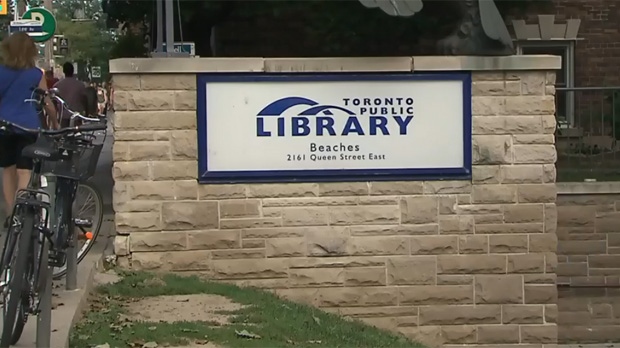
A Toronto Public Library sign is shown in this file photo.


Joshua Freeman, CP24.com
Published Thursday, March 9, 2017 6:19PM EST 
It’s possible that confusion over what is real and fabricated online has never been more acute.
Recently, U.S. President Donald Trump has dismissed news reports which displease him as “fake news,” attacking outlets such as CNN and the New York Times.
Confusingly, the term has also been applied to other news outlets at the extreme ends of the political spectrum, some of which support Trump.
Just in time to help save readers from a possibly embarrassing misapplication of a “fake news” hash tag, the Toronto Public Library has assembled a handy guide to help online readers decipher legitimate news from news that is indeed fake.
“We got some inspiration from some other guides we saw soon after the U.S. elections,” said librarian and online communications lead Mabel Ho. “The guide itself is targeted for Toronto residents and also for our staff as well.”
Ho said it’s a natural fit for the library to issue a guide that helps people asses the quality of information they’re seeing online.
“The library has always been a place for people to get facts,” she said.
While the library hasn’t noticed a spike in confused patrons, helping people understand the difference between authoritative and questionable sources of information online is an ongoing effort, according to Ho.
“We’ve all come across something at one point that we’ve fallen for as well, so it’s not always something that’s easy for people to figure out,” she said. “It’s not something we’re seeing more of, but it is something that’s common – for people to see something and assume that it’s the real thing.”
Appropriately title “How to Spot Fake News,” the library’s guide offers definitions for fake news, tips for assessing whether an article is likely real or fake, links to reliable fact-checking sites and further library resources.
 “We’ve made it pretty easy to use,” Ho said. “So that they (users) can first and foremost understand what fake news is and then how you can spot it.”
The guide compliments courses the library offers for new digital users and aims to help fill a gap that Ho acknowledges exists in digital literacy.  
“We want to encourage Toronto residents to be more thoughtful and critical when they’re looking at those information sources,” Ho said.
To that end, the Toronto reference Library will also be offering an event on digital literacy in June with media scholar Tim Woo and BuzzFeed Media Editor Craig Silverman.
“Digital literacy is definitely one of those things we’re behind in and we want to encourage more of,” Ho said.
The Toronto Public Library’s guide to fake news can be found at tpl.ca/spotfakenews

Thursday, March 9, 2017

Engadget: Google helps libraries encourage kids to code


Mountain View teamed up with the American Library Association for 'Libraries Ready to Code.'


Shutterstock / Andresr


Google has added a new project to its list of library programs, which include WiFi hotspot lending. The tech titan has teamed up with the American Library Association (ALA) to launch "Libraries Ready to Code," an initiative that aims to help equip librarians with the right skills and tools to encourage kids to code. It won't turn every librarian into a coding expect, but it will train them to be able to provide an introduction to computer science.


The program will give them the knowledge necessary to be able to conjure up and implement the right (fun!) CS programs for their communities. It will also help Library and Information Science schools redesign their tech and media courses for fledgling librarians by adding various CS activities.

Google and ALA are hoping the project can turn libraries into a place where kids from all backgrounds can start exploring the world of computer sciences. As Crystle Martin, Secretary of the Young Adult Library Services Association, said:


"Libraries and library staff can create opportunities for youth to gain basic exposure and a basic interest in coding. From there, with support and mentorship from librarians and staff, they can develop long term engagement and possibly computer science as an envisioned future."
From: Engadget