With no fixed address, two men start Toronto's only underpass library
Two men start makeshift libraries on lower Simcoe Street
By Stéphane Blais, CBC NewsPosted: Sep 03, 2015 1:31 PM ET Last Updated: Sep 03, 2015 4:20 PM ET
Elwin Murphy, now an amateur librarian, is bilingual and originally came from the East Coast. (Stephane Blais/CBC)
Al is an avid reader. He estimates he reads a different book every two days. He reads so much, people give him new books all the time.
Al had so many books, he and a friend decided to start their own library.
Only Al has no fixed address. He lives on the street, and so his upstart library is also on the street.
Toronto's new library is under a small bridge on Lower Simcoe Street in Toronto.
"Passersby who noticed my interest in literature began to bring me books. As I have many, I decided to create a library," said Al, an armed forces veteran who did not want to divulge too much about his identity or past.
Lower Simcoe Street has heavy foot traffic - people who now stop and peruse the underpass library's selection of books. (Stephane Blais/CBC)
Al lives on the west side of the Simcoe underpass. His library partner is Elwin Murphy, who lives on the east side.
Al's collection is called The Free Underpass Library, and Murphy's is The East Side Simcoe Library. Al's library has about 40 books, and Murphy's has about 20.
Al's library contains 40 books right now, from titles like Fifty Shades of Grey to children's books, books on politics, biographies of historical figures, and some DVDs. Elwin keeps his collection to 20 books, "because if the authorities ask us to leave, we can put everything in a shopping trolley and clear off. "
The two amateur librarians created signs for the library with a cardboard box.
Literature as wealth
Murphy, who is 52, also counts reading as a pastime. On his makeshift bed of a pile of blankets, he reads detective novels and historical books. He's in the middle of Persian Fire, on the clash between the Persian and Greek empires.
Without shelter, Murphy spent much time in public libraries, but said security guards would "harass him" and always asked him to leave. When Al came up with the idea of creating a library, he saw the opportunity to satisfy his passion for literature without being disturbed.
Murphy said the books have made him intellectually wealthy, and allow him to travel around the world, all while remaining in the underpass.
"Some people believe that I do this to make money, but that is not the case," he said.
"We only wish people would take the books home, and in exchange, bring in a new book. We want the books circulating."
A man with no fixed address began to lend out his book collection this summer. (Stephane Blais/CBC)
Murphy said others with no fixed address borrow their books. "The homeless have no radio, no television or smart phones; only books allow us to escape," he said.
He said the books, while they allow him to take his mind off his life, also connect him to people around him.
Pedestrians used to walk by without acknowledging the men living in the underpass. But now they stop, take photos, ask questions and often leave with a book.
It’s official: reading is good for you, according to a new report from The Reading Agency which looked at the effects of reading for pleasure on adults and children. Benefits include increased empathy, better relationships with others, reduced symptoms of depression and risks of dementia and improved well-being throughout life.
The Reading Agency, a charity whose mission is to inspire people to read more, commissioned the large-scale study to help it evaluate the impact of the work it carries out. Researchers analysed 51 papers and reports, all published within the past 10 years, most of which aimed to assess the impact of reading on literacy and academic success. But this study looked for the non-academic side effects of reading for pleasure, which included better communication between parents and children, increased self-esteem, reduced anxiety and stress and a greater understanding of other cultures.
Some of the information about dementia, for instance, came from two population-level studies in the United States, which showed that “being engaged in more reading, along with other hobbies, is associated with a lower subsequent risk of incidents of dementia. This was especially the case for reading fiction, over and above newspapers and magazines.”
Some of the report’s conclusions about the cultural benefits of reading were drawn from a 2007 study, which showed that “the most consistent outcomes reported were the ability to learn about the self and others, learning about diverse human populations and other cultures and learning about other periods of history. Respondents who read more frequently were also reported to have an enhanced ability to understand other people’s class, ethnicity, culture and political perspectives.”
Consumption of books is linked to a subsequent lowering in the risk of dementia
Unfortunately for the UK, our levels of reading for enjoyment are not the highest. The Reading Agency has found that most children do not read on a daily basis, and almost a third of adults don’t read for pleasure. According to the Progress in International Reading Literacy Study, the percentage of pupils in England who “like reading” is only 26 – lower than the international mean of 28 per cent and 20 per cent lower than in Portugal. “It’s very interesting that outcomes of reading are based on enjoyment,” said Sue Wilkinson, chief executive of The Reading Agency, pointing out that the outcomes of reading for children, in particular, are more pronounced if the reading is undertaken voluntarily by the child.
So how should parents encourage their children to read for fun? Susan Elkin, a journalist, former teacher and the author of Please Miss, We’re Boys, taught English in secondary schools to both girls and boys, for 36 years.
“It’s all to do with stereotyping, role modelling and expectation”, she said. “Boys see their mothers reading but often not their fathers, so they copy. They also tend to be more fidgety and slower to mature than their sisters.”
Ms Wilkinson’s three top tips are: take your children to the library and get them involved in reading activities such as The Reading Agency’s Summer Reading Challenge; make sure that they see you reading; and read to them as well as with them – make it a fun part of every day and something you do together.
The Summer Reading Challenge last year saw 839,622 children take part – an increase on the previous year and a figure that included 44 per cent boys. World Book Night, which attempts to put books into the hands of people who wouldn’t usually read them, received 5,000 responses to a survey about its effectiveness. In all, 97.6 per cent of people were happy to receive a book and 60 per cent said they had read more since, while 40 per cent said they had bought more books.
The next step for The Reading Agency is to decide which five or six outcomes it wants to measure in more detail. Writer Philip Pullman is President of the Society of Authors, one of the organisations involved in the survey. He said: “I agree whole-heartedly with what this report is saying about the importance of reading for pleasure. The writer Samuel Johnson apparently didn’t say this, but someone did and it remains true: ‘The true aim of writing is to enable the reader better to enjoy life, or better to endure it.’”
We’ve all seen a picture of the Kansas City Public Library, yeah? That gorgeous facade never gets old. But what if I told you there are bookish murals attached to bookish places all around the world? Here I list a few:
This gorgeous mural is painted at La Bibilothèque de la Cité in Lyon, France. (credit image 1, image 2) It’s painted by local artists and houses books by local authors.
Iowa barber gives haircuts to children in exchange for them reading stories to him
MIKE BURLEY, Telegraph Herald via AP
Courtney Holmes, right, listens to Jeremiah Reddick, 9, of Dubuque, as he reads while receiving a free haircut Saturday during the Back to School Bash in Comiskey Park, in Dubuque. Holmes offered his services to children who read while getting their hair cut.
August 11, 2015 8:00 am
DUBUQUE (AP) | Children who read books to a local barber have received a free haircut as part of a community event in Dubuque to help families prepare for the upcoming school year.
Barber Courtney Holmes traded the tales for trims on Saturday during the second annual Back to School Bash in Comiskey Park.
Tayshawn Kirby, 9, of Dubuque, read from "Fats, Oils and Sweets," by Carol Parenzan Smalley, informing Holmes that the average person eats 150 pounds of sugar each year. Before Tayshawn's 10-year-old brother, Titan Feeney, took his turn in the barber chair, he told his brother the new look was great.
"I just want to support kids reading," Holmes said.
St. Mark Youth Enrichment gave away books during the event, some of which were read to Holmes. Outreach coordinator Beth McGorry with St. Mark said she enjoyed watching Holmes help young children sound out the words they didn't know yet.
Caitlin Daniels, grade-level reading coordinator with the Community Foundation of Greater Dubuque, also helped struggling readers in the barber chair.
"It's great. All the kids, they want to have a good haircut to go back to school," she said. "They're paying through reading."
The city's acting resource manager, Anderson Sainci, coordinated the event, which involved nonprofits and other community partners.
More than 100 people learned about free resources and before- and after-school opportunities available to families and students. The first full day of classes in Dubuque is Sept. 1.
Nicky Morgan, the Education SecretaryPhoto: Reuters
The Education Secretary says it is a “national mission” to improve levels of literacy levels of young children and says every junior school student in the country will be enrolled in a local library.
Every junior school student in the country will be enrolled in a local library,Nicky Morgan will pledge today as she vows to make English pupils "the most literate children in Europe".
The Education Secretary said it is a “national mission” to improve levels of literacy levels of young children.
Officials will work with schools in a bid to get every eight-year-old in the country enrolled at their local library, Mrs Morgan said.
The Government drive to improve literacy comes after the Organisation for Economic Co-operation and Development in 2013 found that England was 22nd for literacy and 21st for numeracy out of 24 countries, behind countries including Estonia, Poland and Slovakia.
Writing in the Telegraph alongside comedian David Walliams, who is supporting the project, Mrs Morgan warmed that “for some children, reading is, quite literally, a closed book”.
“Improving children’s literacy should be a national mission,” they said. “Whether that means teachers running book clubs, schools enrolling pupils in libraries, publishers donating books, or simply parents reading with their children.”
Officials in the education department hope that the drive could stop closures of libraries across the country.
Local authorities often close libraries and justify their decision by saying that there are not enough members to warrant continued funding.
However, with hundreds of children being signed up, it will be increasingly difficult for councils to close libraries.
Mrs Morgan and Mr Walliams added: “One in five children still leaves primary school unable to read well enough to succeed at secondary school – a figure that rises to one in three of our poorest children. And, if we don’t address illiteracy, it’s the disadvantaged who miss out most of all.
“This is a question of social justice. People with strong reading skills are overwhelmingly more likely to succeed at school, achieve good qualifications, and find a rewarding and enjoyable career. They are even more likely to enjoy good health. By contrast, those who don’t master reading in school suffer the consequences for the rest of their lives, where they may struggle to get good jobs or achieve their full potential.
“No matter where they live or what their background, every single child in this country deserves the opportunity to read, to read widely, and to read well.”
A survey in June revealed that British school leavers are the worst in Europe for the “essential skills” needed to complete entry-level jobs in business.
Four in ten of firms polled in the UK felt that candidates for junior jobs lacked "functional skills, basic literacy and numeracy", compared to 18 per cent of European firms.
Libraries lead the way to digital citizenship. They should be the first places where most advanced technologies are implemented.
Today, libraries are not only about lending books. They are creative spaces, not only for individuals, but also teams. They are economic incubators and learning hubs.
Most of all, the libraries are the entry points to the digital world. They are the way to embrace technology and avoid digital exclusion.
Therefore, to improve technological literacy of local communities, libraries should be equipped with relevant technologies.
In this articles you won’t find examples of how to use Google Hangouts for library meetings, or Pikochart to create library infographics.
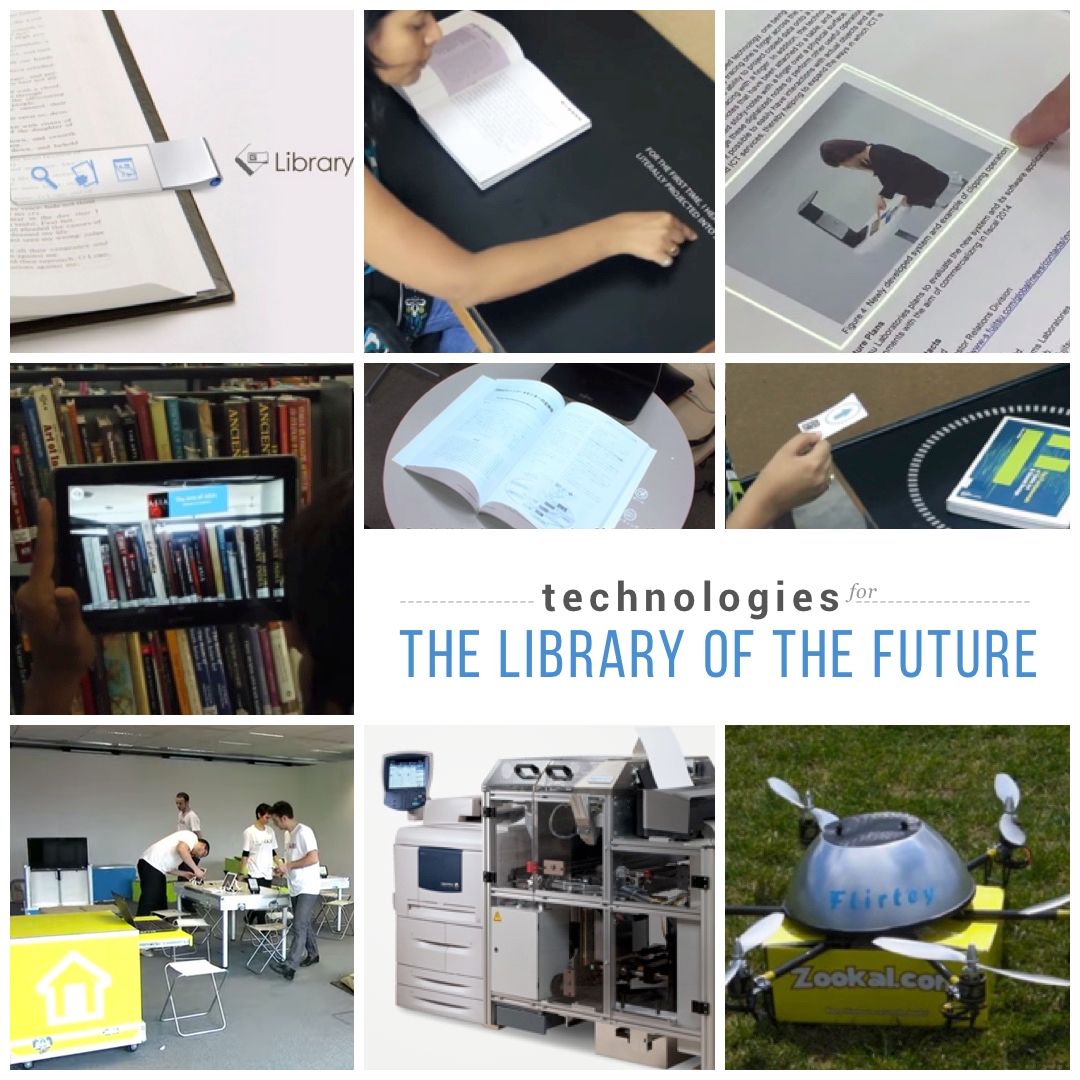
Instead, I would like to go one step further and present technologies – some of them in a concept phase – that could be used in the future.
And instead of general ideas, like wearables or augmented reality, you’ll see here real examples.
Some of these technologies seem to eat budgets dozens of times bigger than a public library can afford, but it’s not the point of this article.
The article is designed to spot technologies that will be relevant and useful in the libraries as they move along their digital roadmaps.
8 technologies we would love to see in the libraries
1. Library bookmark and guide
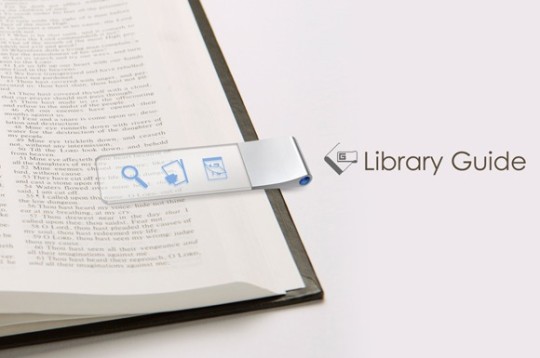
An interesting concept from a Chinese design company Toout. This little tiny device is in the first place a regular bookmark. But on top of that it also has features that could make using the library much easier.
First of all, the device would be a perfect companion when navigating through the library, by giving turn-by-turn directions to the book the patron wants.
The device could also keep track of all borrowed books, as well as remind the user of the return dates.
Finding a book easily without knowing the Dewey Decimal Classification system? Sounds like a good idea of where the library card could evolve.
librARi is a concept of an image based augmented reality application, created by Pradeep Siddappa.
A lot has been said about using augmented reality in libraries, but there are few examples that would let us actually see it.
The video explaining how librARi works (AR in the name stands for “augmented reality”) is very decent, but it’s a benefit. It clearly highlights the best use of AR in libraries – locating the books on the shelves and navigating to them.
The app would point you to the new arrivals. It would also be able to find and point to similar books. Simple, but useful, and very probable.
To get the book from a library, you can either go and find it, or you can let it find you.
The future belongs to unmanned flying machines, and just like Amazon drones can deliver the goods to customers, libraries could deliver the books to patrons.
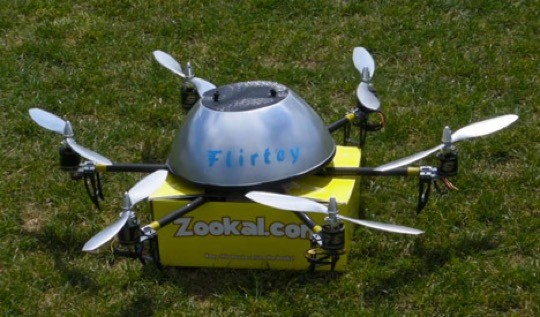
Library drone is not even the close future. It’s already happening. Australian start-up Flirtey has teamed up with a book rental service Zookal to create – the first in the world – textbook delivery system.
The system is using hexacopters, drones with six rotors, to deliver ordered textbooks. Now, the smart thing is that the drone can find you by the location of your smartphone, so there is no need to give a fixed address.
Just imagine. You are sitting in a reading room of the New York Public Library, in the middle of writing an essay, and want to get another book. Stay where you are, and use the app to order a book. The drone will come,just like this one. Pull out the book from the box, and put the one or ones you don’t need any longer. The drone will place them where they belong.
I would personally add an option to deliver latte from a library cafeteria.
Anyone who tried ebooks would never give up the convenience of a digital interface and all other helpful tools.
Searching the content of the book (including smart search), looking for a reference on the web, getting an instant translation, writing notes, or collecting book passages – all this can be done on the same device that we use to read an ebook.
We can obviously borrow an ebook instead of a print book, but here is a better idea – enhance the print book with a digital interface.
FingerLink is a project currently developed by Fujitsu that will let you use digital tools to work with a printed book.
It’s a stand you can put on a library desk. It includes two elements: a camera to read the info from the real world, and the projector to display digital info in the real world.
Simply, place the book on a table under the stand, and you’ll see extra options, available for the book. It’s because everything what FingerLink “sees” can be available and editable in a digital form.
Now let’s push the imagination a bit further.
Nimble is a concept of an advanced library augmented reality tool.
Designed by a London-based interactive designer and Google engineer Sures Kumar, Nimble does not only offer digital enhancement of a print book, but also incorporates the idea featured earlier in the post – the turn-by-turn library guide.
All these features can be accessed using the smart library card. An all-in-one solution to let patrons use the digital books to work with whichever content they want.
Obviously, introducing a system like FingerLink will exceed library’s yearly budget several times. There is a cheaper alternative. A library could offer patrons a variety of small utensils they could borrow to use in the reading room.
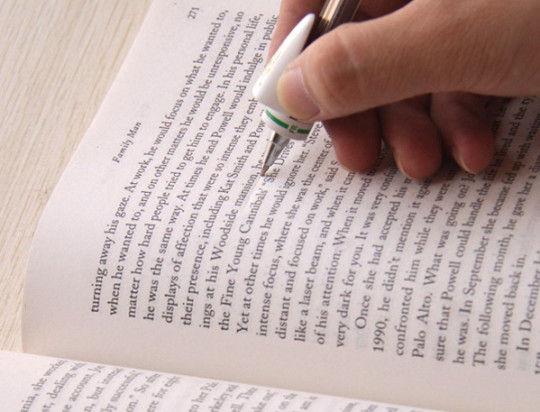
In the picture above you see Ivy Guide, a concept device, that you can put on your pen to use for translating words found in the print book.
It’s just an example showing that such concepts are being created. The only thing is to find the most useful task for the library use.
For me, it could be a simple pen that would let patrons make digital highlights. One condition – it should be done in a simplest possible way.
Here is the idea. The real-to-digital highlighter would be connected to a computer. When you highlight something – move along the text in a print book – it will immediately appear in the notepad app on a computer. All your highlights would be collected in a single text document.
When you are finished, simply send this note to your email address. The note will self-destruct the moment you close it.
Such library utensils would be useful for less tech-savvy library patrons or those who don’t use advanced apps (for instance the ones with OCR – optical character recognition) on their phones.
Sometimes, to engage local communities, or reach people in remote locations, the library would want to physically leave the library building.
The Ideas Box is a revolutionary concept developed by Librarians Without Borders, with the aim to reach people in refugee camps and impoverished countries, but could be also used any time the idea of a mobile library is considered.
The most thrilling thing about this modern library center is that it can be assembled in less than 20 minutes.
The Idea Box is a portable toolkit – standardized, easy to transport and set up. The kit consists of six boxes (including library and internet access), fits on two palettes, and creates a space of 1,000 square meters.
The library box includes 250 paper books, 50 e-readers with thousands of ebooks, and a variety of educational apps.
Bookless libraries, where you can’t find a single print book, launch regularly. They obviously won’t kill traditional libraries, just like ebooks don’t kill print books. The digital-only route has its disadvantages.
To me, every digital-only library should offer their patrons the ability to instantly make a print version of the book. Let’s put aside the question who is going to pay for this. The most important question is that sometimes the book has to be real to make use of it.
Espresso Book Machine (EBM) is a real product. Manufactured by Xerox, it’s sold by On Demand Books. It can make a paperback book while you wait, printing up to 150 pages per minute.
The machine is connected to an online catalog of over seven million in-copyright and public domain books, but institutions using EBM can also print custom titles.
This sounds like an super simple idea, but it doesn’t exist yet, and I’m not sure whether it will.
All the concepts presented above were about special devices or solutions designed for special use in a library.
Nowadays, if you want to borrow an ebook from a library you need to have a special app from a digital content provider, like OverDrive. But not all the libraries cooperate with OverDrive – and it’s where problems begin. The more special something is, the fewer people will use it.
The thing is that to borrow a print book from a library, you don’t need anything special besides the library card.
Imagine that many of the features described above would be accessible from a simple app – a browser on your mobile phone. You’d need it to browse the library, borrow a book, get notifications when it’s due, and finally, be able to read it.
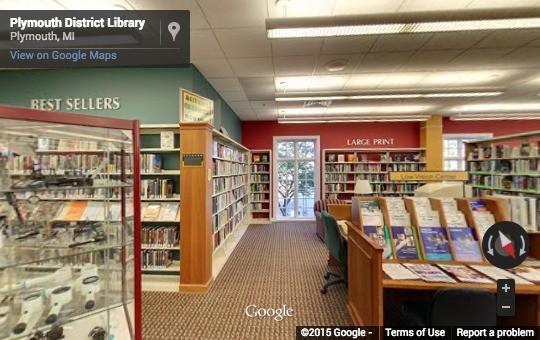
Maybe there would be an option to take a virtual walk through the library. We’re close, just look at the libraries using Google Street View tours. Maybe there would be an option to make notes and highlights. Maybe there would be an option to recognize the printed text and turn it to editable notes.
Yes, all these features are available, but they are delivered by special apps, and these special apps are not meant to be used in libraries.
The idea (utopian?) is that everybody could use the library, and no extra knowledge and software would be needed for that.
Google is leading the way to unify online experience. No extra sign ups. All you need is to be signed in to your Gmail account on Google Chrome.
About Piotr Kowalczyk
Founder of Ebook Friendly. Ebook enthusiast, technology geek, iPhone artist, and self-published author from Poland.