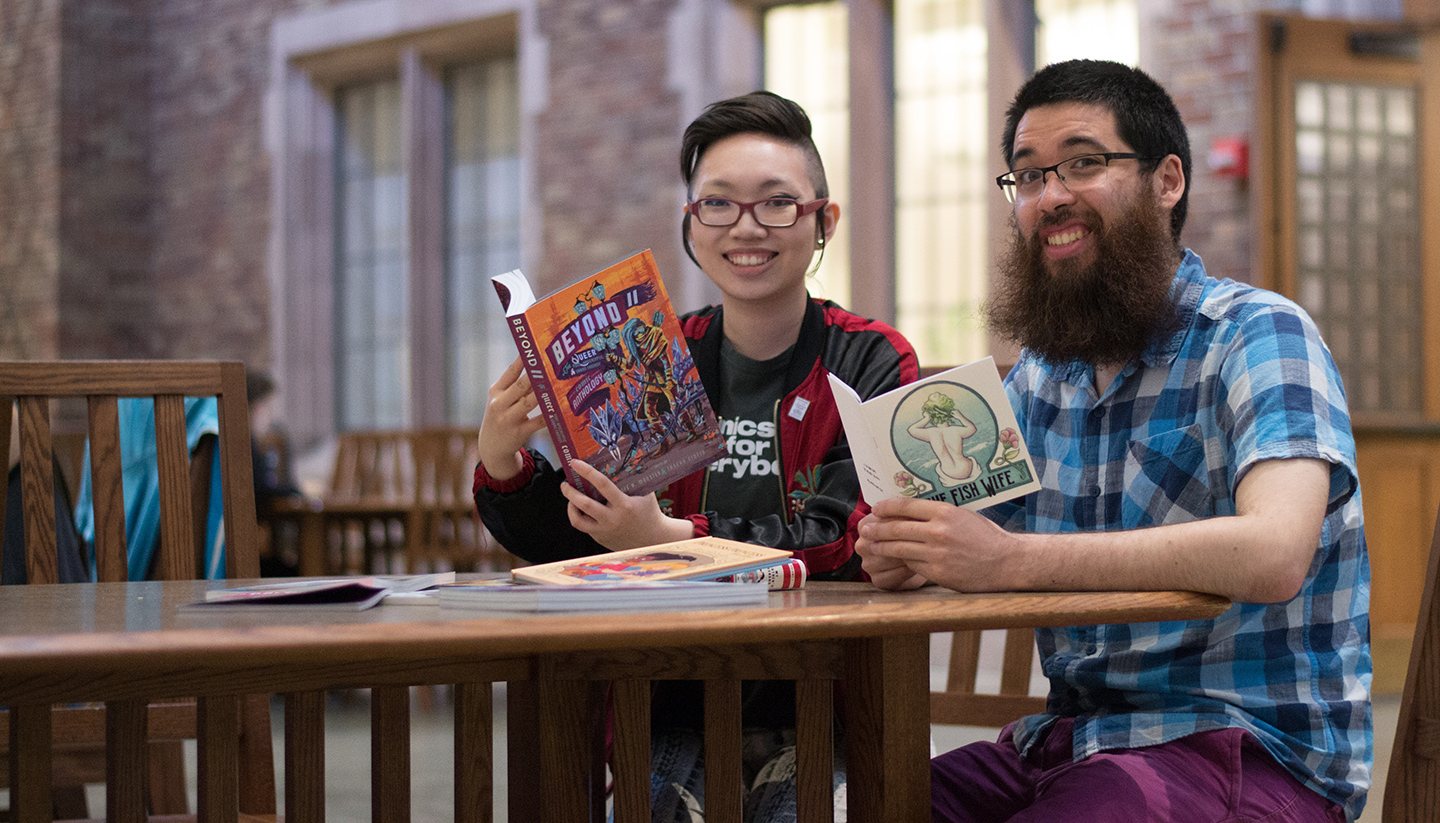
Academic development and civic engagement also positively affected.
by: Paul Irish
Forget the cliche of the introverted bookworm: A recent report suggests people who read more may have better social skills than those who don’t.
A recently released report commissioned by the National Reading Campaign (NRC) titled Towards Sustaining and Encouraging Reading in a Canadian Society found that reading increases empathy, academic development and even civic engagement.
The NRC, a volunteer group of writers, teachers, librarians, parents and publishers dedicated to making Canada a country of readers, analyzed close to 100 domestic and international studies on the subject of reading.
Sharon Murphy, lead author of the paper and associate professor of education at York University, says reading — especially fiction — shows preferred behaviour by example (through characters, plots and situations).
“It helps the reader understand relationships better and how to act in our society,” she says. “Readers can become civic minded … they understand the concept of volunteering and co-operating.”
She also said sitting down with a book increases empathy and, of course, academic development.
As well, the research discovered that if children were allowed to choose what to read as children — instead of being forced to read certain texts — they would be more likely to read as adults.
Ben McNally, owner of the Ben McNally Books on Bay and Richmond Sts., said the findings don’t come as a surprise but agrees it’s refreshing to hear the message when it may be needed most.
“Yes, reading is good … but don’t confuse reading with that flash of information you get off your phone or computer,” he says. “Even to comprehend basic news — what’s happening in your community — needs more than a casual glance at a screen. It’s ludicrous to believe you can really understand the issues without spending some time reading.”
McNally says social media and the internet have their place, but the benefits following the nuances, plots and character compositions of a good novel aren’t likely duplicated by Facebook.
The report also confirmed that boys and men don’t read as much as girls and boys.
“It’s not quite clear why,” said Murphy. “It could be that they’re doing more online activity (than females) and it’s certainly an area for a lot more documentation leading to a bigger study.”
Lisa Heggum, the Toronto Public Library’s Children and Youth Advocate, said the library has been an enthusiastic partner and advocate for the NCR sharing the same goals.
“The important research that the NRC is gathering shows that choice, variety and access to reading materials are critical in promoting reading for all ages,” she says. “Libraries are uniquely and ideally positioned to provide universal access to a broad range of materials.”
Rick Wilks, vice-chair of the NRC, says the findings confirm reading creates benefits through all the social interaction linked to reading, including people connecting through book clubs.
“It confirms our understanding of the individual and societal importance of reading, but perhaps more importantly, it confirms that getting people talking about their reading is the best way to encourage others to read,” he says.
from: Toronto Star
Librarians' Group
A blog dedicated to keeping abreast of issues and ideas in the profession.
Tuesday, May 21, 2013
Monday, May 20, 2013
Libraries: Cathedrals of Our Souls
by: Caitlin Moran
This piece was previously published in The Times of London, and is included in Caitlin Moran's new book, Moranthology ($14.99, Harper Perennial).
Home educated and, by seventeen, writing for a living, the only alma mater I have ever had is Warstones Library, Pinfold Grove, Wolverhampton.
A low, red-brick box on grass that verged on wasteland, I would be there twice a day--rocking up with all the ardor of a clubber turning up to a rave. I read every book in there--not really, of course, but as good as: when I'd read all the funny books, I moved on to the sexy ones, then the dreamy ones, the mad ones; the ones that described distant mountains, idiots, plagues, experiments. I sat at the big table and read all the papers: in public housing in Wolverhampton, the broadsheets are as incongruous and illuminating as an Eames lamp.
The shelves were supposed to be loaded with books--but they were, of course, really doors: each book-lid opened as exciting as Alice putting her gold key in the lock. I spent days running in and out of other worlds like a time bandit, or a spy. I was as excited as I've ever been in my life, in that library: scoring new books the minute they came in; ordering books I'd heard of--then waiting, fevered, for them to arrive, like they were the word Christmas. I had to wait nearly a year for Les Fleurs du Mal by Baudelaire to come: even so, I was still too young to think it anything but a bit wanky, and abandoned it twenty pages in for Jilly Cooper. But Fleurs du Mal, man! In a building overlooked by a Kwiksave where the fags and alcohol were kept in a locked, metal cage, lest they be stolen! Simply knowing I could have it in my hand was a comfort, in this place so very very far from anything extraordinary or exultant.
Everything I am is based on this ugly building on its lonely lawn--lit up during winter darkness; open in the slashing rain--which allowed a girl so poor she didn't even own a purse to come in twice a day and experience actual magic: traveling through time, making contact with the dead--Dorothy Parker, Stella Gibbons, Charlotte Brontë, Spike Milligan.
A library in the middle of a community is a cross between an emergency exit, a life raft and a festival. They are cathedrals of the mind; hospitals of the soul; theme parks of the imagination. On a cold, rainy island, they are the only sheltered public spaces where you are not a consumer, but a citizen, instead. A human with a brain and a heart and a desire to be uplifted, rather than a customer with a credit card and an inchoate "need" for "stuff." A mall--the shops--are places where your money makes the wealthy wealthier. But a library is where the wealthy's taxes pay for you to become a little more extraordinary, instead. A satisfying reversal. A balancing of the power.
Last month, after protest, an injunction was granted to postpone library closures in Somerset. In September, both Somerset and Gloucestershire councils will be the subject of a full judicial review over their closure plans. As the cuts kick in, protesters and lawyers are fighting for individual libraries like villagers pushing stranded whales back into the sea. A library is such a potent symbol of a town's values: each one closed down might as well be six thousand stickers plastered over every available surface, reading "WE CHOSE TO BECOME MORE STUPID AND DULL."
While I have read a million words on the necessity for the cuts, I have not seen a single letter on what the exit plan is: what happens in four years' time, when the cuts will have succeeded, and the economy gets back to "normal" again. Do we then--prosperous once more--go round and re-open all these centers, clinics and libraries, which have sat, dark and unused, for nearly half a decade? It's hard to see how--it costs millions of pounds to re-open deserted buildings, and cash-strapped councils will have looked at billions of square feet of prime real estate with a coldly realistic eye. Unless the government has developed an exit strategy for the cuts, and insisted councils not sell closed properties, by the time we get back to "normal" again, our Victorian and post-war and 1960s red-brick boxy libraries will be coffee shops and pubs. No new libraries will be built to replace them. These libraries will be lost forever.
And, in their place, we will have thousands more public spaces where you are simply the money in your pocket, rather than the hunger in your heart. Kids--poor kids--will never know the fabulous, benign quirk of self-esteem of walking into "their" library and thinking, "I have read 60 percent of the books in here. I am awesome." Libraries that stayed open during the Blitz will be closed by budgets.
A trillion small doors closing.
from: HuffingtonPost
This piece was previously published in The Times of London, and is included in Caitlin Moran's new book, Moranthology ($14.99, Harper Perennial).
Home educated and, by seventeen, writing for a living, the only alma mater I have ever had is Warstones Library, Pinfold Grove, Wolverhampton.
A low, red-brick box on grass that verged on wasteland, I would be there twice a day--rocking up with all the ardor of a clubber turning up to a rave. I read every book in there--not really, of course, but as good as: when I'd read all the funny books, I moved on to the sexy ones, then the dreamy ones, the mad ones; the ones that described distant mountains, idiots, plagues, experiments. I sat at the big table and read all the papers: in public housing in Wolverhampton, the broadsheets are as incongruous and illuminating as an Eames lamp.
The shelves were supposed to be loaded with books--but they were, of course, really doors: each book-lid opened as exciting as Alice putting her gold key in the lock. I spent days running in and out of other worlds like a time bandit, or a spy. I was as excited as I've ever been in my life, in that library: scoring new books the minute they came in; ordering books I'd heard of--then waiting, fevered, for them to arrive, like they were the word Christmas. I had to wait nearly a year for Les Fleurs du Mal by Baudelaire to come: even so, I was still too young to think it anything but a bit wanky, and abandoned it twenty pages in for Jilly Cooper. But Fleurs du Mal, man! In a building overlooked by a Kwiksave where the fags and alcohol were kept in a locked, metal cage, lest they be stolen! Simply knowing I could have it in my hand was a comfort, in this place so very very far from anything extraordinary or exultant.
Everything I am is based on this ugly building on its lonely lawn--lit up during winter darkness; open in the slashing rain--which allowed a girl so poor she didn't even own a purse to come in twice a day and experience actual magic: traveling through time, making contact with the dead--Dorothy Parker, Stella Gibbons, Charlotte Brontë, Spike Milligan.
A library in the middle of a community is a cross between an emergency exit, a life raft and a festival. They are cathedrals of the mind; hospitals of the soul; theme parks of the imagination. On a cold, rainy island, they are the only sheltered public spaces where you are not a consumer, but a citizen, instead. A human with a brain and a heart and a desire to be uplifted, rather than a customer with a credit card and an inchoate "need" for "stuff." A mall--the shops--are places where your money makes the wealthy wealthier. But a library is where the wealthy's taxes pay for you to become a little more extraordinary, instead. A satisfying reversal. A balancing of the power.
Last month, after protest, an injunction was granted to postpone library closures in Somerset. In September, both Somerset and Gloucestershire councils will be the subject of a full judicial review over their closure plans. As the cuts kick in, protesters and lawyers are fighting for individual libraries like villagers pushing stranded whales back into the sea. A library is such a potent symbol of a town's values: each one closed down might as well be six thousand stickers plastered over every available surface, reading "WE CHOSE TO BECOME MORE STUPID AND DULL."
While I have read a million words on the necessity for the cuts, I have not seen a single letter on what the exit plan is: what happens in four years' time, when the cuts will have succeeded, and the economy gets back to "normal" again. Do we then--prosperous once more--go round and re-open all these centers, clinics and libraries, which have sat, dark and unused, for nearly half a decade? It's hard to see how--it costs millions of pounds to re-open deserted buildings, and cash-strapped councils will have looked at billions of square feet of prime real estate with a coldly realistic eye. Unless the government has developed an exit strategy for the cuts, and insisted councils not sell closed properties, by the time we get back to "normal" again, our Victorian and post-war and 1960s red-brick boxy libraries will be coffee shops and pubs. No new libraries will be built to replace them. These libraries will be lost forever.
And, in their place, we will have thousands more public spaces where you are simply the money in your pocket, rather than the hunger in your heart. Kids--poor kids--will never know the fabulous, benign quirk of self-esteem of walking into "their" library and thinking, "I have read 60 percent of the books in here. I am awesome." Libraries that stayed open during the Blitz will be closed by budgets.
A trillion small doors closing.
from: HuffingtonPost
Friday, May 17, 2013
Reading Around
On board a Freightliner M2 20K lorry, a mobile library devised by Alumnos47 and PRODUCTORA uses whatever changes it finds in the city to create its stage, turning imagination into collective memory.
by: María García Holley
At a time when digital information is replacing almost every kind of printed document, iPhones, iPads, Kindles and other similar portable devices have become books. It is hard to imagine the concept of a mobile library without immediately thinking of downloading its volumes from the Internet. Many people would regard it as an anachronism to think that a library could still have any relevance as an architectural typology in the face of the digital upheaval that has changed the ways we approach information and objects, transforming entire industries, such as the video, music and printing industries.
Unlike the idea of electronic books and digital collections, the A47 mobile library is a counter-current notion. It champions the physical nature of the printed book, which it supports with a full cultural programme. A truck carrying over 1,200 volumes of visual art and culture, the A47 travels the streets of Mexico City, providing the residents of various neighbourhoods in the capital with access to its contents.
The A47 Mobile Library is a project developed by the Fundación Alumnos47, a civil society organisation that brings learning communities together around contemporary artistic practices and visual culture. Given that the foundation's major project is to build a public contemporary art museum by around 2014, it seemed reasonable to use a mobile unit to activate the museum's existing collection until the building to house it is completed.
Designing this unit turned into a veritable challenge. How do you take something so opposite to a piece of architecture as a lorry and turn it into not just a library, but a structure capable of hosting an entire spectrum of cultural activities? Looked at in this way, the archaic idea of building libraries started to regain a sense of modernity. Working on this premise, Mexican architecture studio PRODUCTORA came up with the design for a cultural centre within a 20 square metres space on board a Freightliner M2 20K lorry — a travelling building.
The lorry operates primarily as an itinerant collection of contemporary art books. However, beyond this use, every centimetre of its 20 square metre surface area is harnessed to maximum effect to achieve true functionality of space. The bookshelves have left their traditional form behind, instead being dismantlable trays floating above the library users, visually crowning the interior space. The free plan becomes a flexible, transparent platform that relates directly with the urban and social context. The lorry is a forum that can be used as a venue for an endless number of activities: book presentations, film clubs, poetry readings, workshops, as well as the opportunity to consult its bibliographic holdings.
The floor of the lorry comprises a series of mobile platforms giving access to the bookshelves, allowing the space to be re-arranged according to the different activities taking place. The micro perforated sheet surround acts as a permeable membrane that merges the outside and inside, making the space an exercise in honesty with its environment. From the street, one's view of the transparent intricacy that suspends the large solid volume allows a glimpse of the diverse range of titles inside, while also acting as an urban beacon through the night. This illumination — produced by the lorry's own integrated electricity generator — provides a reassuring glow when the streets fall dark, and announces the start of its nightly programme.
Famous names such as Lola Álvarez Bravo, Paul Strand, Roland Barthes and Laurie Anderson are among those to be discussed in the workshops that give purpose to this modern device. There are story readings and drawing sessions for children, while for adults there is the historiography and oral history of the colony. The raised platform of the A47 allows users to make use of the library in much the same way that an actor appropriates the stage.
It is through this quest for new purposes that users experience the change in the idea of what a library means. Far from being an inert archive, the A47 mobile library is a living organism enabling new approaches that turn imagination into a collective memory. This is a lorry that uses whatever changes exist in the city to create its stage. A mechanical insect that, when night falls, can fold away its legs, stow away its stories and continue with its journey.
from: Domusweb
by: María García Holley
At a time when digital information is replacing almost every kind of printed document, iPhones, iPads, Kindles and other similar portable devices have become books. It is hard to imagine the concept of a mobile library without immediately thinking of downloading its volumes from the Internet. Many people would regard it as an anachronism to think that a library could still have any relevance as an architectural typology in the face of the digital upheaval that has changed the ways we approach information and objects, transforming entire industries, such as the video, music and printing industries.
Unlike the idea of electronic books and digital collections, the A47 mobile library is a counter-current notion. It champions the physical nature of the printed book, which it supports with a full cultural programme. A truck carrying over 1,200 volumes of visual art and culture, the A47 travels the streets of Mexico City, providing the residents of various neighbourhoods in the capital with access to its contents.
The A47 Mobile Library is a project developed by the Fundación Alumnos47, a civil society organisation that brings learning communities together around contemporary artistic practices and visual culture. Given that the foundation's major project is to build a public contemporary art museum by around 2014, it seemed reasonable to use a mobile unit to activate the museum's existing collection until the building to house it is completed.
![]() |
| Alumnos47 and PRODUCTORA, A47 Mobile Library, Mexico City |
Designing this unit turned into a veritable challenge. How do you take something so opposite to a piece of architecture as a lorry and turn it into not just a library, but a structure capable of hosting an entire spectrum of cultural activities? Looked at in this way, the archaic idea of building libraries started to regain a sense of modernity. Working on this premise, Mexican architecture studio PRODUCTORA came up with the design for a cultural centre within a 20 square metres space on board a Freightliner M2 20K lorry — a travelling building.
The lorry operates primarily as an itinerant collection of contemporary art books. However, beyond this use, every centimetre of its 20 square metre surface area is harnessed to maximum effect to achieve true functionality of space. The bookshelves have left their traditional form behind, instead being dismantlable trays floating above the library users, visually crowning the interior space. The free plan becomes a flexible, transparent platform that relates directly with the urban and social context. The lorry is a forum that can be used as a venue for an endless number of activities: book presentations, film clubs, poetry readings, workshops, as well as the opportunity to consult its bibliographic holdings.
The floor of the lorry comprises a series of mobile platforms giving access to the bookshelves, allowing the space to be re-arranged according to the different activities taking place. The micro perforated sheet surround acts as a permeable membrane that merges the outside and inside, making the space an exercise in honesty with its environment. From the street, one's view of the transparent intricacy that suspends the large solid volume allows a glimpse of the diverse range of titles inside, while also acting as an urban beacon through the night. This illumination — produced by the lorry's own integrated electricity generator — provides a reassuring glow when the streets fall dark, and announces the start of its nightly programme.
Famous names such as Lola Álvarez Bravo, Paul Strand, Roland Barthes and Laurie Anderson are among those to be discussed in the workshops that give purpose to this modern device. There are story readings and drawing sessions for children, while for adults there is the historiography and oral history of the colony. The raised platform of the A47 allows users to make use of the library in much the same way that an actor appropriates the stage.
![]() |
| Alumnos47 and PRODUCTORA, A47 Mobile Library, Mexico City |
from: Domusweb
Thursday, May 16, 2013
Author Gives Fake Writing Assignments to Online Cheaters
by: Jason Boog
Term paper writing companies flourish online, but few people ever get to read their handiwork.
South Park, Louie, and The Chris Rock Show writer Vernon Chatman sent surreal homework assignments to writers working in the cheating industry. He republished his homework assignments and the actual essays he received in the new book, Mindsploitation: Asinine Assignments for the Online Homework Cheating Industry. Here’s a sample request:
"My midterm thesis essay paper is an exploration of Alternate Endings To Great Works of Literature. All I need from you is to come up with some Alternate endings to some Great works of literature … Provide a new ending to Catcher In The Rye where Holden Caulfield turns into a crawfish and goes into some kind of retail business."
from: GalleyCat
Term paper writing companies flourish online, but few people ever get to read their handiwork.
South Park, Louie, and The Chris Rock Show writer Vernon Chatman sent surreal homework assignments to writers working in the cheating industry. He republished his homework assignments and the actual essays he received in the new book, Mindsploitation: Asinine Assignments for the Online Homework Cheating Industry. Here’s a sample request:
"My midterm thesis essay paper is an exploration of Alternate Endings To Great Works of Literature. All I need from you is to come up with some Alternate endings to some Great works of literature … Provide a new ending to Catcher In The Rye where Holden Caulfield turns into a crawfish and goes into some kind of retail business."
from: GalleyCat
Wednesday, May 15, 2013
How a Scottish farmer became crime fiction’s next big thing
James Oswald thinks up plots on his cattle and sheep farm, and has just won a six-figure deal
by: Tom Rowley
James Oswald is talking about his success as a crime writer when he suddenly becomes distracted and turns to the computer on his battered desk. His “lamb cam” shows a live feed from the shed some 500 yards across the fields. “I think that’s a little head,” he says, pointing excitedly.
We cut across a field of ewes to his polytunnel. Inside, a tiny newborn lamb is crouching next to a ewe. “Here comes the second one,” Oswald shouts, as it emerges and crouches on the straw while the ewe licks it warm. He creates a new pen so the ewe and its lambs won’t be disturbed by the rest of the flock. At last, Oswald is satisfied: “I’ll leave her to clean them up.
“I’ve been up since 5.30am,” he explains as we head back indoors. “As I was giving them hay earlier, I noticed one of them was struggling a bit and I had to help the lamb out. This is as hands-on as it gets.”
Oswald’s days are about to get even busier. On Thursday, his debut novel, Natural Causes, will be published, and two more are expected to hit bookshelves by next spring. He will have to juggle writing and farming with interviews and book-signings.
The 45-year-old already has experience of such success, however. In fact, he has become a self-publishing phenomenon, racking up 350,000 online sales for Natural Causes and its sequel, The Book of Souls, when he released them last year for download to e-readers such as the Kindle. The figures astonished publishing houses that are normally impressed by first-time authors who can sell 20,000 books, and Oswald was soon at the centre of a bidding war to publish his work in book form. Penguin won the auction, while the international rights have already been sold to six countries. The book has proved a critical success, too, making the shortlist for the Crime Writers’ Association Debut Dagger Award.
So Oswald could be forgiven for relishing this moment in the limelight, booking a London venue for a glitzy bash on Thursday night. Instead, the book will be officially launched in… the Dundee Waterstones.
He points across to the city from his window, showing how convenient the party will be. His view is rather wider than that, however. His home overlooks the River Tay, some two miles wide as it reaches its mouth. Twenty minutes’ drive south of Perth, Oswald can see the Grampian mountains to the west on a good day, while the Tay stretches to the North Sea beyond Dundee to the east.
Oswald shares the study-cum-kitchen with three dogs; his partner, Barbara, will soon join him. Logs stand next to the wood-burning stove, and a whiteboard pinned above his desk is covered with scrawled ideas for future novels.
“I’ve always wanted to write,” says Oswald, perched on a black leather chair, incongruous among the dog blankets that clutter the floor. “I just love telling stories. My uncle told my mother when I was four that I’d be a writer because of the tall tales I used to tell. But you can’t be a full-time writer unless you’re really, really lucky, so you need to have a day job.”
He has worked on farms since he graduated from Aberdeen University in 1990, first doing odd jobs in Scotland before settling in rural Wales, working as an agricultural consultant.
He had just bought a house there with Barbara five years ago when two police officers knocked on his door one day at 3am to tell him his parents, David and Juliet, had died. Their pick-up truck had collided with a car on the A9 in an accident that also killed a Dutch man and his young son. Oswald inherited the 350-acre farm he had hungered for in the toughest of circumstances. “I’d always wanted to take over – but after my dad retired, not after an accident like that. It was enormously traumatic. I had no enthusiasm for anything at all. I certainly didn’t want to write, and I didn’t write for about two years.”
He moved to the farm and prepared to abandon his dream to tend his 12 Highland cattle and 50 New Zealand Romney sheep. In despondent mood, he realised the publishers had been right to turn down Natural Causes when his agent had hawked it around a few years previously.
But at the Harrogate Crime Writing Festival a few weeks later, he got talking to Allan Guthrie, whose first e-book had just sold very successfully. “I hadn’t really cottoned on to the whole Kindle thing, but I just had to pay $80 for the cover to be designed and for a few beers for my friends for proofreading. I thought I’d give it one more go.”
Within weeks Oswald was shifting 2,000 copies a day. Readers loved his protagonist, Edinburgh’s Det Insp Tony McLean, who combines old-fashioned sleuthing with supernatural intuition, and Natural Causes soon topped Amazon’s e-book chart.
“Nothing gives you your self-confidence back like 350,000 people downloading your book,” he grins. “The sales figures are updated in real time and it was really addictive. I had to ration myself to only checking them after a day on the farm.”
Far from finding it a bind, he says his day job helps him to write. “If I’m on the tractor, it’s not mentally taxing so I can just think through plots. If I go for a walk and I lose the dogs because it’s all going off in my head, then that’s brilliant. My notebook is never far away, so I can scribble things down. It has all sorts of questionable stains on it.”
He was mending a fence in a hailstorm when his agent called with the result of the auction. “My fingers were barely working, but I managed to get the phone out. She said she’d done a six-figure deal. I thought, 'I can pay someone to come and do this fencing for me’.” He quickly frittered some of the money away on such luxuries as a new tractor.
The hefty advance suggests that Penguin considers Oswald in the same bracket as Ian Rankin and Val McDermid. So surely he can give up the day job? “I could never move,” he insists. “For all that it is bloody hard work, there is something magical about lambing and calving. I could do my writing in a city staring out at a brick wall – but this is the view I want.”
from: Telegraph
by: Tom Rowley
James Oswald is talking about his success as a crime writer when he suddenly becomes distracted and turns to the computer on his battered desk. His “lamb cam” shows a live feed from the shed some 500 yards across the fields. “I think that’s a little head,” he says, pointing excitedly.
We cut across a field of ewes to his polytunnel. Inside, a tiny newborn lamb is crouching next to a ewe. “Here comes the second one,” Oswald shouts, as it emerges and crouches on the straw while the ewe licks it warm. He creates a new pen so the ewe and its lambs won’t be disturbed by the rest of the flock. At last, Oswald is satisfied: “I’ll leave her to clean them up.
“I’ve been up since 5.30am,” he explains as we head back indoors. “As I was giving them hay earlier, I noticed one of them was struggling a bit and I had to help the lamb out. This is as hands-on as it gets.”
Oswald’s days are about to get even busier. On Thursday, his debut novel, Natural Causes, will be published, and two more are expected to hit bookshelves by next spring. He will have to juggle writing and farming with interviews and book-signings.
The 45-year-old already has experience of such success, however. In fact, he has become a self-publishing phenomenon, racking up 350,000 online sales for Natural Causes and its sequel, The Book of Souls, when he released them last year for download to e-readers such as the Kindle. The figures astonished publishing houses that are normally impressed by first-time authors who can sell 20,000 books, and Oswald was soon at the centre of a bidding war to publish his work in book form. Penguin won the auction, while the international rights have already been sold to six countries. The book has proved a critical success, too, making the shortlist for the Crime Writers’ Association Debut Dagger Award.
So Oswald could be forgiven for relishing this moment in the limelight, booking a London venue for a glitzy bash on Thursday night. Instead, the book will be officially launched in… the Dundee Waterstones.
He points across to the city from his window, showing how convenient the party will be. His view is rather wider than that, however. His home overlooks the River Tay, some two miles wide as it reaches its mouth. Twenty minutes’ drive south of Perth, Oswald can see the Grampian mountains to the west on a good day, while the Tay stretches to the North Sea beyond Dundee to the east.
Oswald shares the study-cum-kitchen with three dogs; his partner, Barbara, will soon join him. Logs stand next to the wood-burning stove, and a whiteboard pinned above his desk is covered with scrawled ideas for future novels.
“I’ve always wanted to write,” says Oswald, perched on a black leather chair, incongruous among the dog blankets that clutter the floor. “I just love telling stories. My uncle told my mother when I was four that I’d be a writer because of the tall tales I used to tell. But you can’t be a full-time writer unless you’re really, really lucky, so you need to have a day job.”
He has worked on farms since he graduated from Aberdeen University in 1990, first doing odd jobs in Scotland before settling in rural Wales, working as an agricultural consultant.
He had just bought a house there with Barbara five years ago when two police officers knocked on his door one day at 3am to tell him his parents, David and Juliet, had died. Their pick-up truck had collided with a car on the A9 in an accident that also killed a Dutch man and his young son. Oswald inherited the 350-acre farm he had hungered for in the toughest of circumstances. “I’d always wanted to take over – but after my dad retired, not after an accident like that. It was enormously traumatic. I had no enthusiasm for anything at all. I certainly didn’t want to write, and I didn’t write for about two years.”
He moved to the farm and prepared to abandon his dream to tend his 12 Highland cattle and 50 New Zealand Romney sheep. In despondent mood, he realised the publishers had been right to turn down Natural Causes when his agent had hawked it around a few years previously.
But at the Harrogate Crime Writing Festival a few weeks later, he got talking to Allan Guthrie, whose first e-book had just sold very successfully. “I hadn’t really cottoned on to the whole Kindle thing, but I just had to pay $80 for the cover to be designed and for a few beers for my friends for proofreading. I thought I’d give it one more go.”
Within weeks Oswald was shifting 2,000 copies a day. Readers loved his protagonist, Edinburgh’s Det Insp Tony McLean, who combines old-fashioned sleuthing with supernatural intuition, and Natural Causes soon topped Amazon’s e-book chart.
“Nothing gives you your self-confidence back like 350,000 people downloading your book,” he grins. “The sales figures are updated in real time and it was really addictive. I had to ration myself to only checking them after a day on the farm.”
Far from finding it a bind, he says his day job helps him to write. “If I’m on the tractor, it’s not mentally taxing so I can just think through plots. If I go for a walk and I lose the dogs because it’s all going off in my head, then that’s brilliant. My notebook is never far away, so I can scribble things down. It has all sorts of questionable stains on it.”
He was mending a fence in a hailstorm when his agent called with the result of the auction. “My fingers were barely working, but I managed to get the phone out. She said she’d done a six-figure deal. I thought, 'I can pay someone to come and do this fencing for me’.” He quickly frittered some of the money away on such luxuries as a new tractor.
The hefty advance suggests that Penguin considers Oswald in the same bracket as Ian Rankin and Val McDermid. So surely he can give up the day job? “I could never move,” he insists. “For all that it is bloody hard work, there is something magical about lambing and calving. I could do my writing in a city staring out at a brick wall – but this is the view I want.”
from: Telegraph
Tuesday, May 14, 2013
Used e-books for sale? Not so fast
by Hector Tobar
Is it legal to sell a used e-book?
A Massachusetts start-up that hopes to start selling used e-books and other used digital content this summer suffered a legal setback in court recently when a federal judge ruled that it had infringed the rights of Capitol Records by facilitating the resale of copied digital music.
And now a judge in Germany has ruled that digital books can’t be resold by purchasers, ruling against a consumer group that was seeking the right for German readers to do so.
At issue is a very simple legal principle. You can resell a printed book because in doing so you’re not making a copy of it and thus not violating the author’s copyright. What you're not allowed to do is make a copy of the original work and sell that. Generally, when you buy a digital work of art, such as an MP3 or an e-book, what you download is considered an original and if you circulate it, you're making a digital copy.
The Boston start-up ReDigi believes it had solved that issues by giving digital content “physicality.” “ReDigi wants to take legally purchased e-books off your computer, digitally watermark them, and then store them on a cloud-based server,” Boston Magazine reports. In that cloud, the company argues, “it is effectively the right of ownership that is bought and sold.“
A federal judge disagreed.
But, as Boston Magazine writes: “Legal issues aside, many analysts feel these markets are almost inevitable. Amazon has acquired a patent for its own used-digital-media market. Already, each Amazon book page has a space for the price of a used Kindle edition. It’s still blank -- for now, anyway.”
Already, Amazon has a digital lending library, whose content continues to grow.
from: LA Times
Is it legal to sell a used e-book?
A Massachusetts start-up that hopes to start selling used e-books and other used digital content this summer suffered a legal setback in court recently when a federal judge ruled that it had infringed the rights of Capitol Records by facilitating the resale of copied digital music.
And now a judge in Germany has ruled that digital books can’t be resold by purchasers, ruling against a consumer group that was seeking the right for German readers to do so.
At issue is a very simple legal principle. You can resell a printed book because in doing so you’re not making a copy of it and thus not violating the author’s copyright. What you're not allowed to do is make a copy of the original work and sell that. Generally, when you buy a digital work of art, such as an MP3 or an e-book, what you download is considered an original and if you circulate it, you're making a digital copy.
The Boston start-up ReDigi believes it had solved that issues by giving digital content “physicality.” “ReDigi wants to take legally purchased e-books off your computer, digitally watermark them, and then store them on a cloud-based server,” Boston Magazine reports. In that cloud, the company argues, “it is effectively the right of ownership that is bought and sold.“
A federal judge disagreed.
But, as Boston Magazine writes: “Legal issues aside, many analysts feel these markets are almost inevitable. Amazon has acquired a patent for its own used-digital-media market. Already, each Amazon book page has a space for the price of a used Kindle edition. It’s still blank -- for now, anyway.”
Already, Amazon has a digital lending library, whose content continues to grow.
from: LA Times
Monday, May 13, 2013
A glimpse into Guantánamo Bay's library
From the well-thumbed – Danielle Steele – to the untouched classics, pictures posted by US journalists show the reading matter permitted in the world's most controversial prison
by: Nina Martyris
The Pentagon doesn't let journalists talk to prisoners in the Guantánamo Bay detention camp, where more than half of the 166 detainees are currently on hunger strike, but reporters are granted access to the prison library – inspiring a blog from the New York Times reporter Charlie Savage that collects pictures of books uploaded by journalists reporting on Gitmo.
Prisoners aren't allowed to go the library, but they can put in requests for books they want to read. The books are thoroughly checked in case they are being used to exchange messages – any attempts to do so are punished with a suspension of the library facility.
The few thousand titles offer a strange mix of books ranging from the pulpy – Danielle Steele's The Kiss (in Arabic) – to the classic – six copies of David Copperfield – to the canonical – seven copies of Homer's Odyssey. The Steele book looks pretty well-thumbed but it's doubtful if anyone has borrowed Homer to pass the time, although some detainees have been there 11 years – longer than it took Odysseus to return to Ithaca via a perilous journey that included more than a spot of waterboarding at the hands of Poseidon.
Other books include seven copies of Pearl S Buck's The Good Earth, CS Lewis's Narnia series, Tolkien, Stieg Larsson's trilogy, Naguib Mahfouz, a Pashto-to-English dictionary, Captain America comic books, puzzle books, a Russian edition of a National Geographic magazine, Alice in Wonderland, Robinson Crusoe, To Kill a Mockingbird, and Khaled Hosseini's maudlin hit The Kite Runner. Watership Down and Star Wars share shelf space with Aristotle's Nicomachean Ethics. Apart from the books, the video game Angry Birds is also available.
Earlier reports have said that the most popular books are Agatha Christie's mysteries, Kahlil Gibran and the Harry Potter novels. Harry Potter has also been used an in interrogation tactic. According to Fox News, members of Congress visiting the prison in 2005 observed how one interrogator tried to break down a prisoner by reading aloud from a Harry Potter novel for hours – the detainee turned his back and covered his ears to block out the sound.
Among the spy novels is a paperback copy of The Tailor of Panama, John le Carré's hilarious but stinging indictment of fraudulent intelligence gathering – a subject that cuts close to home in a prison of this kind. The 1996 novel was seen as a prescient foretelling of the weapons of mass destruction intelligence scam that paved the way for the US invasion of Iraq. President George Bush opened Guantánamo in 2002 as a important plank of his "war on terror". The 81-year-old le Carré, who has been scathing in his criticism of "Bush and his junta", recently told the New York Times that he keeps a rubber cartoon figure of the former president in his bathroom. He also said he was disappointed in Obama for not closing Guantánamo as he promised to do when he ran for office in 2008.
Obama did sign an executive order to close the prison in 2009 – it was one of the first things he did on entering office – but Congress remains implacably opposed to doing so. With the hunger strike making international headlines, Obama has renewed his call for closure, saying that "the notion that we're going to keep 100 individuals in no man's land in perpetuity" was not "sustainable".
Miami Herald journalist Carol Rosenberg posted a picture of an Arabic translation of Gabriel García Márquez's News of a Kidnapping. She said the book looked "well read". Incidentally, two years ago, this non-fiction book on how the Medellín cartel kidnapped a group of Colombians in the 1990s at the height of the drug war became a bestseller in Iran, after opposition leader Mir Hossein Mousavi told his compatriots that if they wanted to know what it was like for him to be under house arrest, they should read this book.
One of the most borrowed titles is the Arabic self-help book Don't Be Sad, published by the International Islamic Publishing House in Saudi Arabia. It advocates patience, hard work and keeping one's faith in Allah. In the foreword, the publisher states that the book is for everyone, Muslims and non-Muslims, though the solutions are offered from an Islamic perspective. Chapters have titles such as "Extract the honey but do not break the hive", "Isolation and its positive effects", and the quintessentially American "Convert a lemon into a sweet drink". According to Wikipedia, Christian anarchist Elbert Hubbard coined the phrase in 1915 and it was later popularised by Dale Carnegie.
The religious section – inmates are given a copy of the Qur'an to keep with them in their cells – includes Fatwas of the Pillars of Islam and the biography of the Prophet (in French) and several copies, also in French, of Paramahansa Yogananda's Autobiography of a Yogi. The Hindu spiritual teacher, who helped popularise yoga in America, was a great admirer of Mahatma Gandhi – the most famous hunger striker of the 20th century.
from: Guardian
by: Nina Martyris
The Pentagon doesn't let journalists talk to prisoners in the Guantánamo Bay detention camp, where more than half of the 166 detainees are currently on hunger strike, but reporters are granted access to the prison library – inspiring a blog from the New York Times reporter Charlie Savage that collects pictures of books uploaded by journalists reporting on Gitmo.
Prisoners aren't allowed to go the library, but they can put in requests for books they want to read. The books are thoroughly checked in case they are being used to exchange messages – any attempts to do so are punished with a suspension of the library facility.
The few thousand titles offer a strange mix of books ranging from the pulpy – Danielle Steele's The Kiss (in Arabic) – to the classic – six copies of David Copperfield – to the canonical – seven copies of Homer's Odyssey. The Steele book looks pretty well-thumbed but it's doubtful if anyone has borrowed Homer to pass the time, although some detainees have been there 11 years – longer than it took Odysseus to return to Ithaca via a perilous journey that included more than a spot of waterboarding at the hands of Poseidon.
Other books include seven copies of Pearl S Buck's The Good Earth, CS Lewis's Narnia series, Tolkien, Stieg Larsson's trilogy, Naguib Mahfouz, a Pashto-to-English dictionary, Captain America comic books, puzzle books, a Russian edition of a National Geographic magazine, Alice in Wonderland, Robinson Crusoe, To Kill a Mockingbird, and Khaled Hosseini's maudlin hit The Kite Runner. Watership Down and Star Wars share shelf space with Aristotle's Nicomachean Ethics. Apart from the books, the video game Angry Birds is also available.
Earlier reports have said that the most popular books are Agatha Christie's mysteries, Kahlil Gibran and the Harry Potter novels. Harry Potter has also been used an in interrogation tactic. According to Fox News, members of Congress visiting the prison in 2005 observed how one interrogator tried to break down a prisoner by reading aloud from a Harry Potter novel for hours – the detainee turned his back and covered his ears to block out the sound.
Among the spy novels is a paperback copy of The Tailor of Panama, John le Carré's hilarious but stinging indictment of fraudulent intelligence gathering – a subject that cuts close to home in a prison of this kind. The 1996 novel was seen as a prescient foretelling of the weapons of mass destruction intelligence scam that paved the way for the US invasion of Iraq. President George Bush opened Guantánamo in 2002 as a important plank of his "war on terror". The 81-year-old le Carré, who has been scathing in his criticism of "Bush and his junta", recently told the New York Times that he keeps a rubber cartoon figure of the former president in his bathroom. He also said he was disappointed in Obama for not closing Guantánamo as he promised to do when he ran for office in 2008.
Obama did sign an executive order to close the prison in 2009 – it was one of the first things he did on entering office – but Congress remains implacably opposed to doing so. With the hunger strike making international headlines, Obama has renewed his call for closure, saying that "the notion that we're going to keep 100 individuals in no man's land in perpetuity" was not "sustainable".
Miami Herald journalist Carol Rosenberg posted a picture of an Arabic translation of Gabriel García Márquez's News of a Kidnapping. She said the book looked "well read". Incidentally, two years ago, this non-fiction book on how the Medellín cartel kidnapped a group of Colombians in the 1990s at the height of the drug war became a bestseller in Iran, after opposition leader Mir Hossein Mousavi told his compatriots that if they wanted to know what it was like for him to be under house arrest, they should read this book.
One of the most borrowed titles is the Arabic self-help book Don't Be Sad, published by the International Islamic Publishing House in Saudi Arabia. It advocates patience, hard work and keeping one's faith in Allah. In the foreword, the publisher states that the book is for everyone, Muslims and non-Muslims, though the solutions are offered from an Islamic perspective. Chapters have titles such as "Extract the honey but do not break the hive", "Isolation and its positive effects", and the quintessentially American "Convert a lemon into a sweet drink". According to Wikipedia, Christian anarchist Elbert Hubbard coined the phrase in 1915 and it was later popularised by Dale Carnegie.
The religious section – inmates are given a copy of the Qur'an to keep with them in their cells – includes Fatwas of the Pillars of Islam and the biography of the Prophet (in French) and several copies, also in French, of Paramahansa Yogananda's Autobiography of a Yogi. The Hindu spiritual teacher, who helped popularise yoga in America, was a great admirer of Mahatma Gandhi – the most famous hunger striker of the 20th century.
from: Guardian
Subscribe to:
Posts (Atom)