Librarians' Group

A blog dedicated to keeping abreast of issues and ideas in the profession.

Friday, November 28, 2014

Homeless find hope, refuge and community at public libraries

by: Terry Reith & Andrea Huncer

As libraries evolve to reflect the digital age, many are finding their buildings increasingly filled with those from the fringes of society looking for warmth, safety and access to technology. And some of those people are finding unexpected help.
In 2006, Colin Mulholland was homeless, an alcoholic and seething with rage.
"I went through this chaos and ultimately got to the darkest that I've ever been," he said.  
But each morning after leaving a downtown Edmonton homeless shelter, he would make his way to the public library, a place of refuge during those dismal days.
"The library is a natural, because you can come, you can sit. You can read books,” he says. “I'd pretend to read books, because mostly you don't get enough sleep in the missions. So I'd kind of like fake read and sleep."  
Jared Tkachuk is also a regular at the library, but for very different reasons. The veteran social worker was hired to roam the stacks and corridors of the library to seek out and support those like Mulholland who are down on their luck.
"We do a lot of what I call helping to restore dignity for people," he says. "So there's a big social or spiritual component to the job."
Over several months Tkachuk became a friend, listening with a sympathetic ear, and subtly guiding the angry, often drunken Mulhollandonto a new path.
It's a funny story between us,”Mulholland recalls, “because for the first few months that I was bumping into him there I didn't even realize that there was an outreach worker relationship going on between me and him."  
While social work may seem like an unusual role for public libraries, it’s a natural fit in Edmonton, according to Edmonton Public Library deputy CEO PilarMartinez.
“It really is information. It’s a different type of expert that’s providing that information and support so it aligns very, very well with what we’re already doing.”  

A growing trend

A public library can be a warm, safe place, where those without homes, computers or smartphones can check email, Facebook accounts, and even read.
San Francisco was among the first to bring a professional social worker into its library system about six years ago.
“San Francisco was struggling with homeless issues for a number of years,” says library spokeswoman Michelle Jeffers.
​Homeless people were using the library, but staff were having difficulty coping with the complexity of their needs. “They have issues bigger than the librarian can answer for them.”
Having the social worker on site has made a difference, she says.
“People have been placed into housing and are getting back on their feet.”
Several of those helped by the library have returned the favour, working as health and safety associates at the library.
The four paid positions are like an internship that allows people to give back, while acquiring skills and adding to their resumés.
Now at least five libraries in Canada employ social workers.
Brantford Public Library in Ontario added a child and youth worker in 2010 in response to problems with unruly teens.
The program was such a success that it now brings in a speech pathologist, public health nurse and dietitian. And the once unruly teens now form the core of a popular youth café held at the library every Wednesday night.
Success in Brantford led to a pilot project in Hamilton, which has just been made permanent.
“We are a community resource, a community hub,” explains Hamilton library spokeswoman Melanie Southern, who calls the library “a common, safe location.”
In Toronto, a public health nurse now spends three days a week at its reference library. Winnipeg has hired an outreach worker to help patrons connect with social and community agencies.
Other libraries across Canada are watching with interest. In St. Johns, it's an issue of funding, not lack of interest. Regina’s Public Library is watching the national trends.

Nature of homelessness changing

“I think some things have changed,” says Eric Weissman, a sociology professor at College of New Caledonia in Prince George, B.C.
Weissman was drug addicted and homeless as a youth, when the local library was both refuge and community centre. The biggest change, he says, is the nature of homelessness.
“A lot of homeless people actually have jobs and have families and need resources, so they use libraries.” he said. “Libraries have always been that central place, that community centre. It’s one of the mandated qualities of libraries.”
He calls libraries “the Alamo of urban space for the homeless.”  
“It’s a last stand. I mean urban space is stacked up against the poor,” he said. “When people are occupying urban space and reducing its value we tend to push them away.”      
Tkachuk likes to recall the success stories, even if on the surface they may not seem like much.
A year ago he helped a man with schizophrenia and addictions, who had spent 25 years on the street, finally move into a small apartment.
The man never beat his addictions and died last month, just 10 months after moving into his home.
"The first thing a colleague said to me is at least he didn't die on the streets. And sometimes that's a success story.” Tkachuk notes. “And sometimes it's someone going to university.”
Mulholland is the success story the library likes to point to.
Now 47, Mulholland is in his first year of a bachelor of arts program at the University of Alberta. He’s already received a diploma in social work from a community college.
He credits the library and its outreach worker for helping change his life. "He and the library became a safe place for me to reconnect to."  
Mulholland eventually wants to earn a master's degree — a big jump for someone who had no hope and saw no future for himself. He says libraries can make a difference in many more lives.

from: CBC
Posted by Elizabeth at 5:00 PM No comments:

Thursday, November 27, 2014

Bronx library hopes to fill void left after closing of popular community center

The New York Public Library is increasing services such as adult education and English classes at its Highbridge branch after the Highbridge Community Life Center shuttered in June.  
by: Dennis Slattery

A Bronx library is helping to fill a void created by the closure of a beloved community center, expanding English language classes to a neighborhood heavily populated by immigrants.

The basement meeting room of the High Bridge Library was packed Tuesday morning with people who gathered for an informational session regarding the new offerings.

After the room reached capacity — half an hour before the planned start time — dozens more were told to come back in January.


“There is a great deal of need in this neighborhood,” said High Bridge Library manager Margaret Fleesak, 61. “We’ve tried our best to fulfill some of the need.”

The Highbridge Community Life Center shuttered in June after 35 years of serving the area that's isolated by its elevation and two bordering highways.

The popular nonprofit offered English classes, citizenship courses and high school equivalency diplomas to a community in need.

The area has seen an influx of Spanish-speaking immigrants from Mexico and the Dominican Republic along with a growing population of West Africans over the past decade, according to US Census data.

“It was a huge loss to the community,” said Ebrahim Ndure, 50, founder of the Highbridge Islamic Center. “So many here need English classes, GED classes and life skills to get by.”

The Highbridge Community Life Center was forced to close after rising debts and operating costs soared, said former staffer Chauncy Young.


But the library, which underwent a $6.8 million renovation just over three years ago, is doing its best to fill the gap.

“It’s wonderful,” Young said. “One of the biggest needs in the Highbridge area is the adult education classes.”

Yudit Gonzalez praised the New York Public Library for expanding its English for Speakers of Other Languages classes.

“It’s not just learning English,” the 31-year-old mother of two said. “It’s the ability to get a job, to communicate, to help my kids with homework.”

Gonzalez recently completed classes at the library’s main Bronx campus on Kingsbridge Road.

Ndure has been using the library’s basement for citizenship courses.


“We had to expand the program to make sure the impact was minimal,” Ndure said.

The library will continue to expand its programs, trying to meet the needs of all Highbridge residents.

“I want this space to be used,” Fleesak said. “That’s my ambition, and that’s what I fight for.”

from: NY Daily News
Posted by Elizabeth at 5:00 PM No comments:

Wednesday, November 26, 2014

Iceland Reads: The country of 320,000 punches well above its literary weight class

by: Mark Medley

In Reykjavík

When it comes to mail delivery service in Iceland, two days stand out from the rest. The first is when the IKEA catalogue arrives. The second is when the bókatíðindi shows up in the mailbox.

“This is the Christmas catalogue,” says Bryndís Loftsdóttir of the Icelandic Publishers Association, handing over a copy of last year’s glossy, 208-page tome. “It’s always the same,” she continues in an amused tone. “Weeks before this is published we anxiously get phone calls from people asking, ‘When is it coming? Can I get it now?’”

A copy of the bókatíðindi, which lists approximately 90% of the books published in Iceland each year, is mailed to every household in the country, free of charge. While in most countries the presents under the Christmas tree come in all shapes and sizes, Loftsdóttir jokes that in Iceland one finds a row of neatly wrapped books. “The book is still the most popular Christmas present in Iceland,” she says. There’s even a name for the phenomenon: the “jólabókaflóð,” which means Christmas book flood.

There may not be another country on the planet where books enjoy such prominence. For a country that boasts a population of approximately 320,000 people — that’s less than Belize, Brunei, and the Bahamas — Iceland is punching above its weight class. Its publishing industry cranks out roughly 1,000 titles each year (including works in translation) and the country produces more published authors than anywhere else on the planet, Brooklyn be damned. According to a report produced by a consortium of Nordic publishers, in 2012 there were 3.5 published titles for every 1,000 of the country’s inhabitants — a number double that of Finland, Sweden, Norway and Denmark. The average print run for a book is 1,000 copies, the equivalent of one million copies in the United States.

The history of the nation is inextricably linked to the written word; Icelanders produced the Sagas and the Poetic Edda, captivating historical (and sometimes fantastical) records of the country’s early years, filled with heroes, villains and monsters, written down almost a millennium ago and inspiring countless writers, include J.R.R. Tolkien. (A new translation of the Edda will be published by Canadian poet Jeramy Dodds this fall.) Literature has always been part of Iceland’s national identity.

“We really feel, and think, that our little contribution to world literature is worth noticing,” says Sjón, one of the country’s foremost contemporary authors, sitting in a bookstore in downtown Reykjavík on a rainy April morning. “This was a very poor country — a third-world country — until well into the second, third decade of the 20th century,” he says. “We have no cathedrals to show from the past. We have no paintings. We have no symphonies. We’ve got nothing.

“Literature is the only constant cultural activity that has been going on here throughout the centuries.”

It’s an ongoing cultural activity. While the Icelandic Publishers Associations boasts about 40 members, including Forlagið, the largest of the country’s publishing houses, Loftsdóttir says the real number is north of 100 when you factor in tiny indie publishers and pop-up concerns that release a book or two before vanishing. (Although I never got my hands on one of their titles, I kept hearing about Tunglið (Icelandic for moon) which publishes two books every full moon in editions of less than 100.)


“We don’t know very much about banking, but we know about books,” says a smiling Agla Magnúsdóttir of the Icelandic Literature Center, which was created last year to promote Icelandic writing abroad. (Curiously, the economic crash, which was just beginning to strike the country last time I visited, in 2008, may have actually helped book sales: “People kept on buying book, if they didn’t just buy more books,” says Magnúsdóttir. “Instead of weekend trips, they spent the money buying books.”)

In recent years, books by Icelandic authors have proved popular in bookstores outside Reykjavík, too. The English market, especially, has “opened up” during the last five years, says Sjón, who published widely-acclaimed translations of three of his novels with Farrar, Straus and Giroux last year. The turning point, according to many people, was 2011, when Iceland was guest of honour at the Frankfurt Book Fair, the largest annual gathering of the global book trade.

“I think that in some countries that weren’t looking at Icelandic literature seriously, they just said, ‘OK, we might be missing something,’” says Magnúsdóttir. After Frankfurt, it seemed like the country “sold out of works to be translated,” says Loftsdóttir, setting off a wave of interest — in markets around the world — that hasn’t really ceased.

“In terms of publishing abroad, you would think that it would be a disadvantage to have such a small language, but quite a lot of authors have had books published in more than 10 languages,” says Andri Snær Magnason, whose book LoveStar was published in the U.S. in 2012. “It’s very nice to get the chance to get into a bigger room and be considered on par [with] other international writers. It lifts the lid off this small place. It’s given us some confidence.

“You’re not just writing into the void,” he continues. “You can feel the waves.”

Besides Sjón, Icelandic writers making waves include Auður Ava Ólafsdóttir (her new novel, Butterflies in November, will be released in North America in December), Ragna Sigurðardóttir (longlisted for the IMPAC Dublin Literary Award), and crime writers Arnaldur Indriðason and Yrsa Sigurðardóttir, all of whom have benefitted from the spike in interest in Nordic (especially crime) fiction in recent years. (When Indriðason won the Crime Writers’ Association Gold Dagger Award in 2005, Loftsdóttir, who at the time worked for the nation’s largest bookstore chain, Eymundsson, recalls, “We’d get phone calls from publishing houses in England saying ‘What other authors do you have writing crime?’ ”)

In August 2011, Reykjavík became a UNESCO City of Literature, one of only seven in the world and the first non-native English speaking city to receive the designation. Kristín Viðarsdóttir, who spearheads the project, took me on a walking tour through the city streets, where QR-code enhanced plaques are affixed to buildings where writers once lived or which provide the settings for famous books.

“People think about literature as private … but it’s a community thing,” she says. “It’s our mission to bring literature out of books, out of the libraries, out of people’s houses.”

In a way, the entire country is a literary walking tour. When I sat down with Magnason, he recalled how, the previous week, he’d been sailing in a remote part of the country. Though he was practically in the middle of nowhere, the area was the setting of one of the Sagas dating from the 12th century, a 19th century story, and a contemporary crime novel, to name but three examples.

“You have one deserted fjord, and it has layers upon layers of literature — only in that remotest areas of Iceland!” he says. “This is how our landscape is in many places: you don’t see any buildings but it has layers of memory that has been preserved.”

Increasingly, people are visiting Iceland not just for its landscape and hot springs, but for its literary culture. In April, I was a guest of the Iceland Writers Retreat, a new cultural event that brought in a dozen established writers (including Canada’s Joseph Boyden and Susan Orlean and Pulitzer Prize-winner Geraldine Brooks from the U.S.) for four days of lectures, workshops, readings, panel discussions and receptions (including an audience with Iceland’s president, Ólafur Ragnar Grímsson, who spoke at length about the country’s illustrious literary heritage). The event proved so successful — attracting 50 writers from outside the country — that organizers will hold a second next April, with authors Adam Gopnik, Alison Pick and John Vaillant among those confirmed to attend.

“The Icelandic component was critical to the success of the retreat,” says co-organizer Eliza Reid, a Canadian who has lived in Iceland for more than a decade. “This event could not have taken place anywhere else.

“I think it was also important for us to showcase some of this country’s literary heritage to visitors. We live here and so we know about the impact that the Sagas have had on literature, about Halldór Laxness winning the Nobel Prize, and about the increase in popularity in Icelandic crime fiction. But I was pleased that we could show visitors this dimension. Perhaps most importantly, one comment we heard from participants was how happy they were to be recognized as writers: One person in particular mentioned that when she is at home and says she’s a writer, people often then ask her what her ‘real’ job is, or how she can possibly earn a living from that. But in Iceland, locals immediately took that job title seriously and were interested in her work.”

At the end of the week, I visited the home of Halldór Laxness, the country’s only recipient of the Nobel Prize for Literature, which has been transformed into a museum about 20 minutes outside the city. There was a reception for the participants, and Sjón read from one of his novels. Afterwards, at my hotel, I noticed something that had previously escaped my attention: a room bearing Laxness’ name. It turns out the hotel has a dozen themed rooms, named and modelled after famous Icelandic poets, featuring their photos, biographies, and writing on the walls. It seems that in Iceland you’re always surrounded by the country’s literature, even while you sleep.

from: National Post
Posted by Elizabeth at 5:00 PM No comments:

Tuesday, November 25, 2014

Ferguson Library Provides Calm Refuge for a Torn Community

by: Lisa Peet

On November 24 a grand jury in Ferguson, MO, delivered its verdict on the August 9 shooting death of Michael Brown, an unarmed black teenager, by a Ferguson police officer. The St. Louis County grand jury chose not to bring criminal charges against the officer, Darren Wilson; the decision, which was announced just after 8 p.m. CST, set off a night of protests and civil unrest, the most violent including arson, shattered windows, injuries, and, as of press time, a possible murder.
During the nearly four months of unrest since Brown was killed, the Ferguson Municipal Public Library (FMPL) has consistently stepped up to help the town’s citizens, especially its youngest members. Last summer the Ferguson-Florissant School District postponed its schools’ opening day, originally scheduled for August 14, out of fear of violence. Until schools eventually opened on August 25, FPL opened its branches to the district’s teachers, allowing them to set up activities and instruction for students in the library.
As Ferguson awaited the grand jury’s verdict, Governor Jay Nixon had pre-emptively declared a 30-day state of emergency November 17 in anticipation of unrest in Ferguson, a suburb of St. Louis, and the surrounding area. As predicted, demonstrations flared through the night into Tuesday morning, mainly centered around the Ferguson Police Department and the site of Brown’s shooting. As of Tuesday morning 61 arrests had been made in Ferguson and another 21 in St. Louis, and Governor Nixon had ordered additional National Guard reinforcements. Demonstrations occurred across the country as well, in cities such as Atlanta, Los Angeles, New York, Oakland, and Philadelphia.
THE LIBRARY STEPS UP
It was announced the Monday night of the verdict that schools would be closed the following day, and on November 25 once again FMPL opened its doors to the district’s children and their teachers. Scott Bonner, library director of Ferguson Municipal Public Library District, said that while numbers weren’t as high as in August, the library hosted “scores” of children, as well as serving as a safe place for the neighborhood’s adults.
“I’m seeing a mix of moods,” he told LJ. “Our volunteers are excited and optimistic, and here to help, and then I have patrons who come in and literally hold my hands and cry—they just needed someone to hold onto and talk to. And everything in between, including people who are doing the regular walk-in, walk-out stuff.” But, he said, the mood was “a lot more emotional and taut than usual.”
Bonner is FMPL’s lone full-time librarian, working with another 10–11 part-time staff members. When the school closings were announced FMPL put out a call on social media for help, and on Tuesday Teach for America and other organizations responded with more than 50 volunteers. Operation Food Search, a local food bank, served lunch for children who would ordinarily eat at school.
The smallest children, Bonner noted, were happy to come in and do their activities. Recent events were harder on teenagers, however. Middle- and high-schoolers tended to act out, giving voice to their anxiety and anger. But while Bonner had expelled a few teens earlier in the week, he said, “Today we haven’t had to kick anyone out.”
A book swap planned for Tuesday night was canceled, as the library decided to close at 4 p.m. for safety reasons. “We don’t know if it’s going to be another night like last night,” Bonner told LJ. “There were people trying to kick in the door of the library last night after we closed.” The book swap, which had been the first event planned by FMPL’s new Teen Council, has been postponed until December.
Appropriately enough, FMPL was one of the galleries hosting art exhibit entitled “Hands Up, Don’t Shoot!” The show was organized by the Alliance of Black Art Galleries to give local artists an opportunity to respond to Brown’s killing. opened October 17 and 18 and will run through December 20. Artwork was exhibited in more than a dozen galleries throughout the area.
AN OUTPOURING OF SUPPORT
While library staff and volunteers did their best to make neighborhood children feel at home, FMPL’s Twitter feed (@fergusonlibrary) Tuesday showed an outpouring of love and support from all over. In addition, calls for action on Twitter, some utilizing the hashtag #whatlibrariesdo, resulted in a huge spike in PayPal donations to the library. “It’s been kind of phenomenal,” Bonner said.
Book donations remain steady as well: when FMPL first opened its doors to students in August Angie Manfredi, head of youth services for Los Alamos County Library System, NM, started a Twitter campaign soliciting books for the library. She created a wishlist for FMPL on Powell’s, which has since been filled and added to. The effort continues to be a great success, and once all the books received have been cataloged, says Bonner, “Thanks to her efforts, we’re going to have one of the strongest collections in the state for civic engagement, civil rights history, and recovering from trauma.”
Librarians across the country are working to help support students and educators as well. A St. Louis school librarian has created a LibGuide for resources about the Brown shooting, and the Twitter hashtag#FergusonSyllabus provides a wide range of links.
Schools had been planned to close Wednesday through Friday for Thanksgiving, so FPL will not be holding classes during that time. But if schools are closed next week, said Bonner, “we’ll do it again.” Bonner reinforced his steadfast approach to the library’s role. “What we’re doing is just what libraries do,” he emphasized to LJ. “We’re in a particularly dramatic situation, but we’re doing the same thing everyone does. And that’s because our libraries are awesome. We’re all about the community, and our doors are wide open to every human being in Ferguson.”
from: Library Journal
Posted by Elizabeth at 5:00 PM No comments:
Labels: public libraries, social issues

Monday, November 24, 2014

Public Libraries: a dying service?

by: Alexandra Hoff

WHTM Harrisburg, Pa.

HARRISBURG, Pa. (WHTM) - It's about books, not bookkeeping - or at least it used to be.

"That's not part of what you learned about when you went to school to be a librarian years ago," said Sue Erdman, Executive Director at the Joseph T. Simpson Library in Mechanicsburg.

In many ways, Erdman has become a full-time fund raiser, the library itself is responsible for 26 percent of their own budget.

"It was just like, well you wont get your second payment this year, and that was it," said Joy Hamsher, director of the New Cumberland Public Library.

Hamsher's library was forced to cut their employees from six to three after they were cut off from a state subsidy program given to boarder-libraries serving a portion of out-of-county residents.

Because of the six-figure cut, they can no longer afford to stay open on Fridays.

"About 50 percent comes from the county, 20 percent comes from the state, and the rest we have to raise," she added.

But that 50 percent has been a strain on the county. So much so that a strategic consulting firm has been brought in to help iron out a future.

"We have a library system board that has its own expert perspective and we have the board of commissioners and we have our own perspective and opinions and we need to bridge those differences," Cumberland County commissioner Gary Eichelberger said.

The county must be able to prove to the taxpayer that libraries have a solid future.

"Every public dollar we put into something we have to be able to spell out exactly what the return to the community is," he said.

In order to stay up-to-date libraries must continuously invest in new technology, and technology takes funding.

So what if the funding fix never comes?


"Well, I guess we'll have to continue to cut," Hamsher said.

from: WHTM/abc27
Posted by Elizabeth at 5:00 PM No comments:

Friday, November 21, 2014

Cool Stuff Librarians Do: Librarians Without Borders

When I was little I wanted to be a doctor, and imagined myself sweeping across continents providing invaluable medical assistance as part of Doctors Without Borders. I came to accept that I’m a writer, not a medical professional, but now I have an opportunity to realign those early dreams with my actual life: I’m interning with the coolest group I know of – Librarians Without Borders. Same basic concept, slightly different product.
Librarians Without Borders (LWB) originated as a student project dreamed up by Founder and Co-Executive Director (and my lovely internship advisor) Melanie Sellar, who was then attending library school at the University of Western Ontario in Canada. Now coming up on its ten year anniversary, the nonprofit is on a mission to “improve access to information resources regardless of language, geography, or religion, by forming partnerships with community organizations in developing regions.” The goal is a global society where all people have equal access to information resources. To that end, LWB has partnered with three groups to promote literacy, libraries, and learning.
The Miguel Angel Asturias Academy in Quetzaltenango, Guatemala is LWB’s longest running partnership. LWB student groups and volunteers work in the Academy’s library, bring books, and provide research into best practices that help expand the library’s collection, programming, and services to assist even more community members. There is a significant lack of access to books for most Guatemalans, where 75% of the population lives in poverty. Getting children excited about books is a work in progress, and the idea of a lending-library is making its first inroads, here in the 21st century. LWB sends groups from their Canadian student committees (codename: “boots on the ground”) on volunteer service trips, and in 2013 worked with the group to transition the library from non-circulating to “one where students and staff can check out books and bring them home.” And all the hard work paid off: in its fourth year, with the help of an on-site librarian funded by LWB, the kids of Asturias went way past a modest reading goal of four books per year, topping off at average of 14. As of 2013, the library had over 3,200 reference materials to help improve students’ learning, and is taking Asterius teacher recommendations into consideration to obtain more.  It’s giving new life to the old catchphrase, Reading is FUNdamental.
Librii, formerly Libraries Across Africa, is a nonprofit that Kickstarteda successful campaign to fund a digitally-enhanced, revenue-generating library in Accra, Ghana. Librii was founded not by librarians but computer engineers, architects and anthropologists from Rice University, and their goal is to deploy the physical library structures, with digital components, throughout Africa. LWB doesn’t build the libraries, they lend the expertise “to assist in shaping the nature of the library and defining the role of the librarian.” LWB helps research necessities like library space issues, ways the group can work to support a culture of reading, and emerging forms of collection development for the nascent library system. Librii is still fundraising towards its goal of deploying its first library in Ghana: an awesome re-purposed shipping container model they hope to have in place by the end of this year. It’s just one small step on a continent where, according to Librii’s research, more than one billion people live, but less than 20% have access to broadband internet, and with it, instant information. But imagine the possibilities.
And LWB’s newest partner, Limitless Horizons (Saber Sin Límites) Ixil serves the community of Chajul, Guatemala, a mostly indigenous village of  subsistence farmers. In Chajul, 93% of residents live in poverty and the community still struggles to overcome the violence and genocide of Guatemala’s devastating 36-year civil war. LWB helps support Chajul’s Community Library, which opened in 2010 as the first and only community library in the area.
Librarians are researchers and information champions, first and foremost, and LWB’s strength is in its partnerships, where project-based learning is the fun, interactive, service-oriented way to spread the information love. What that means, for us three lucky interns from San Jose State University’s School of Information, is providing assistance to LWB’s partner programs in Ghana and Guatemala, researching best practices for start-up, rural libraries in developing areas, promoting the programs through social media bolstering to spread the word (and raise the capital), and basically doing everything we can to help LWB support their programs and goals.
As of 2013, LWB had 1,325 members over 75 countries, including Angola, Morocco, Tanzania, Sri Lanka, Colombia, Czech Republic, and Zimbabwe. Most connect through LWB’s website, and become dedicated volunteers hell bent on propelling LWB forward through its mission statement.
LWB’s tagline is: Putting information in the hands of the world. It’s a simple concept that takes a lot of hard work to achieve. Just another cool thing librarians do.
from: BookRiot
Posted by Elizabeth at 5:00 PM No comments:
Labels: international libraries, Librarians

Thursday, November 20, 2014

Say cheese before checking out at Franklin Park library

by: Mark Lawton

Starting in 2015, patrons of the Franklin Park Library will need to have their photos taken when renewing their library cards.

The library aims to snap shots of all its patrons for its records. The new policy is due to some patrons using library cards that are not their own.

“Sometimes people check out materials on other people’s cards and don’t return them,” said Library Director Marie Saeli. “Other times it has to do with computer use. Someone will [look up] something inappropriate for a library. We will bar their privileges and then the real card owner comes and says, ‘Why can’t I get on the computer?’”

Library clerks can’t tell if a library card actually belongs to a person checking out a book or DVD.

“We confront a person and say ‘You owe materials,’ they frequently say it was used without their knowledge,” Saeli said. “It’s happened frequently enough to be something we’re concerned about.”

In other news, the library will offer patrons the opportunity to view a history of materials they’ve checked out in the past.

“In case they want to look at the book again or check out a CD again and can’t remember what it’s called,” Saeli said.

That service isn’t new to the area. The Chicago Public Library system instituted this feature in the last year when it last upgraded its website.

The service is optional and, said Saeli, completely private.


“Staff will not be accessing this,” she said.

from: Franklin Park Herald-Journal
Posted by Elizabeth at 5:00 PM No comments:

Wednesday, November 19, 2014

The Brain on Architecture

Looking at buildings designed for purposes of contemplation—like museums, churches, and libraries—may have positive measurable effects on mental state.
by: Emily von Hoffmann

At a particular moment during every tour of Georgetown’s campus, it becomes necessary for the student guide to acknowledge the singular blight in an otherwise idyllic environment.  

“Lauinger Library was designed to be a modern abstraction of Healy Hall”: a sentence that inevitably trails off with an apologetic shrug, inviting the crowd to arrive at their own conclusions about how well it turned out. Much of the student population would likely agree that the library’s menacing figure on the quad is nothing short of soul-crushing. New research conducted by a team of architects and neuroscientists suggests that architecture may indeed affect mental states, although they choose to focus on the positive.

I spoke with Dr. Julio Bermudez, the lead of a new study that uses fMRI to capture the effects of architecture on the brain. His team operates with the goal of using the scientific method to transform something opaque—the qualitative “phenomenologies of our built environment”—into neuroscientific observations that architects and city planners can deliberately design for. Bermudez and his team’s research question focuses on buildings and sites designed to elicit contemplation: They theorize that the presence of “contemplative architecture” in one’s environment may over time produce the same health benefits as traditional “internally-induced” meditation, except with much less effort by the individual.

Contemplative architecture contains a series of design elements that have historically been employed in religious settings: Bermudez noted that it is “logical to expect societies not only to notice [the link between built beauty and experience] over time, but to exploit it as much as possible in their places for holy purposes.” These elements may be used in any place intended for contemplation or discovery, whether of a spiritual, personal, or even scientific nature. Architectural Digest wrote of the “modernist beacon” The Salk Institute for Biological Studies in La Jolla, California:
The nonprofit research center … interweaves private and public spaces with a strikingly formal, inward-looking plan that echoes the format of a medieval cloister. Composed of strong-willed yet sensuous materials—travertine and reinforced concrete—it possesses a hushed dignity that encourages contemplation.

Two six-story laboratory buildings form the north and south boundaries of the complex. Each shelters an inner row of angular semidetached office structures that face each other across a travertine courtyard. Bisecting it all is a channel of water that seems to pour into the Pacific below. The buildings, fashioned of concrete accented with teak, focus one’s gaze on the horizon so “you are one with the ocean,” observes admirer Jim Olson, a partner in the Seattle firm Olson Kundig Architects.
By showing 12 architects photos of contemplative and non-contemplative buildings from facade to interior, the researchers were able to observe the brain activity that occurred as subjects "imagined they were transported to the places being shown."

All of the architects were white, right-handed men with no prior meditative training, creating the necessary (if comical) uniformity for neuroscientific research—the team wanted to ensure that the brain scans would not be influenced by factors unrelated to the photos, like gender, race, or handedness. For instance, the brain scans of left- and right-handed people often look different even when subjects are performing the same task.

In addition to posing an interesting control on the experiment, the decision to use architects was a strategic one meant to increase the researchers’ chances of achieving conclusive results. Though everyone encounters architecture, studies on the built environment struggle for funding because, as Bermudez remarked with a sigh, “it’s difficult to suggest that people are dying from it.” Architects were a natural choice for the pilot study because, the team reasoned, their critical training and experience would make them sensitive to features of the buildings that a lay person might overlook.

He conceded that the team "totally loaded the deck" by examining a horde of architects as they perused photos of the "most beautiful buildings mankind has ever produced.” Among others, the sites in the “contemplative” experimental group include La Alhambra, the Pantheon, the Chartres Cathedral, the Salk Institute, and the Chapel of Ronchamp. In response to a critic at the presentation he gave at the Academy of Neuroscience for Architecture (ANFA) shortly after the study's conclusion, Bermudez explained that the goal of the pilot study is to reveal something interesting that warrants additional funding for an extension of the experiment using the general population. “It may be a limitation of the system,” Bermudez added, “but it’s what everyone has to do.”

The challenge began when the researchers set out to measure an experience few have paused to identify—they deployed online surveys in Spanish and English to gather testimony on extraordinary architectural experiences (EAEs), or encounters with places that fundamentally alter one’s normal state of being. Critically, most of the buildings or sites mentioned in the 2,982 testimonies were designed with contemplation in mind, whether spiritual, aesthetic, religious, or symbolic, leading the researchers to conclude that “buildings may induce insightful, profound, and transformative contemplative states, [and] buildings designed to provoke contemplation seem to be succeeding” to a great degree. In addition to churches, mosques, and other types of religious buildings, some art galleries, monuments, homes, and museums are examples of contemplative architecture—the Guggenheim in Bilbao, the Louvre in Paris, and Frank Lloyd Wright’s “My Home” in Fallingwater were in the top 10 sites referenced in the surveys.

Anticipating skeptics who would claim that these experiences are subjective, the researchers expanded the question to draw on the established neuroscientific subfield of meditation, with some important differences. Related studies to date have focused on internally produced states that are easily replicated in the lab, and on aesthetic evaluation, or the activity that occurs in the orbital frontal cortex as we make snap judgments about whether we find things ugly or beautiful.

Bermudez and his team expected that architecturally-induced contemplative states would be strong, non-evaluative aesthetic experiences— eliciting more activity in areas associated with emotion and pleasure, but less activity in the orbital frontal cortex.

The presence of an external stimulus (the photos of the buildings) also removes the tedious self-regulation that occurs in the prefrontal cortex during traditional meditation. The interviews of the 12 subjects revealed that “peacefulness and relaxation, lessening of mind wandering, increasing of attention, and deepening of experience” were all common effects of viewing the photos—also common was a slight element of aesthetic judgment, seemingly inescapable in the crowd of critics.

The provisional conclusions of the study are that the brain behaves differently when exposed to contemplative and non-contemplative buildings, contemplative states elicited through “architectural aesthetics” are similar to the contemplation of traditional meditation in some ways, and different in other ways, and, finally, that “architectural design matters.”

That last conclusion sounds anticlimactic after all this talk of lobes and cortices, but it reinforces a growing trend in architecture and design as researchers are beginning to study how the built environment affects the people who live in it. ANFA proclaims that “some observers have characterized what is happening in neuroscience as the most exciting frontier of human discovery since the Renaissance.”

Other findings discussed at ANFA’s conference get even more into the gritty details: the optimal ceiling heights for different cognitive functions; the best city design for eliciting our natural exploratory tendencies and making way-finding easier; the ideal hospital layout to improve memory-related tasks in patients recovering from certain brain injuries; the influence of different types and quantities of light within a built space on mood and performance.  

I didn’t ask Bermudez what the fMRIs might reveal if his subjects were shown pictures of Lauinger Library, though. I suspect it wouldn’t be pretty.

from: The Atlantic
Posted by Elizabeth at 5:00 PM No comments:

Tuesday, November 18, 2014

5 New Literary Publications to Watch

by: Jonathan Sturgeon

If you’re worrying about the health of new literary projects: don’t. Although it may seem as if we’re stuck with the perpetual reinvention of old institutions (and there’s nothing exactly wrong with that), things are, in reality, speeding along quite nicely when it comes to new, literary quality publications. There are so many tantalizing forthcoming (and just-begun) projects, in fact, with a variety of refreshing approaches, that we put together this primer to get you ready. These publications promise to deliver the best personal and literary essays, poetry, interviews, and academic writing.

Freeman’s
John Freeman was the president of the National Book Critics Circle before he left for London to edit Granta. More recently, he was the author of How to Read a Novelist, an excellent collection of interviews with authors like Philip Roth and Marilynne Robinson. Last month, Freeman published Tales of Two Cities (with OR Books), one of the best recent essay collections on New York City. He is, in other words, a busy guy. His next project is Freeman’s, an anthology-style publication born of a partnership between Grove/Atlantic and the New School. From what we know now, it will publish twice a year, and its ideal readers, Freeman says, are “people who are curious, crazed for fiction, morally engaged, disturbed by the status quo, and who want a reliable guide for the best writers alive.”

The Butter
A dream team collaboration between The Toast and the infinite Roxane Gay, The Butter, according to The Toast’s co-founder Mallory Ortberg, will be “WHATEVER ROXANE WANTS IT TO BE.” More specifically, according to Gay, The Butter will “focus on cultural criticism and personal essays that make readers think and feel.” It’s hard to imagine a better collaboration, or a better editor, for essays and criticism in 2015 and beyond.

Prelude
Prelude is a promising new poetry publication “unofficially” linked to n+1 magazine. Founded by Rob Crawford, Frank Guan, and Stu Watson, it promises to deliver on several things, in no particular order:
1. “To present the full panoply of poetic diversity currently happening around the world…”
2. “To promote diversely powerful poems of aesthetic and political merit…”
3. To present “works from a variety of aesthetic traditions with the only unifying criteria being that these pieces seek to engage with the political realities of contemporary life.”
Sounds good! The first issue will feature Ariana Reines, John Ashbery, Ann Lauterbach, Chris Hosea, Rebecca Wolff, John Kinsella, Jenny Zhang, and others.

The Happy Reader
A forthcoming collaboration between Penguin and “the brains behindFantastic Man,” The Happy Reader represents an altogether new concept. The first half of the magazine will feature a long-form interview with a “notable book fanatic,” and the second half will dig in to a single classic of literature by way of film, fashion, lifestyle, history, and more.

Public Books
A well-edited and exciting site that features writing from academics both young and tenured, Public Books avoids the pitfalls of most academic writing with its range and quality. A look at the current issue will show you that it covers “The Salinger Riddle” as deftly as it does “The Piketty Effect.” This, to my mind, is the preferable direction for accessible writing from academics, away from the madness ofBuzzAdemia.

from: Flavorwire
Posted by Elizabeth at 5:00 PM No comments:

Monday, November 17, 2014

Your brain has a biological response to a good book

New research reveals that reading a novel can 'trick' your brain and 'transport you into the body of the protagonist.'

by: Laura Moss

Getting wrapped up in a good novel actually causes changes in your brain that can last for at least five days, according to new research.
 
Emory University scientists found that reading an absorbing book results in heightened connectivity in the left temporal cortex, a region of the brain linked to language and sensory motor skills.
 
Neurons in this area of the brain are associated into tricking the mind into thinking the body is doing something it's not, a phenomenon known as grounded cognition.
 
"The neural changes that we found associated with physical sensation and movement systems suggest that reading a novel can transport you into the body of the protagonist," neuroscientist Gregory Berns, lead author of the study, told The Independent.
 
"We already knew that good stories can put you in someone else’s shoes in a figurative sense. Now we’re seeing that something may also be happening biologically."
 
Twenty-one students participated in the study by reading a portion of the same book in the evening and then having an fMRI scan the next morning. (Functional magnetic resonance imaging, or fMRI, measures brain activity by detecting the changes in blood oxygenation and flow that occur in response to neural activity.)
 
Robert Harris’ bestselling 2003 thriller "Pompeii" was chosen for the study because of its fast-paced plot.
 
Once the students had finished the book, their brains were scanned for the next five days.
 
Berns found that the neurological changes in participants' brains lasted for five days after finishing the book, persisting in a similar way to muscle memory.

from: Mother Nature Network
Posted by Elizabeth at 5:00 PM No comments:

Friday, November 14, 2014

Moscow Metro's virtual library offers free e-books to commuters

by: Katie Davis

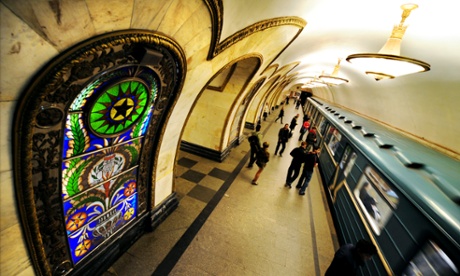
Novoslobodskaya metro station on the Moscow metro, one of the most heavily used underground transport systems in the world. Russia
Novoslobodskaya metro station on the Moscow metro, one of the most heavily used underground transport systems in the world. Photograph: Linda Nylind
Its design is already hailed as a masterpiece of modern art, now Moscow’s metro system is increasing its cultural credentials by opening a virtual library of Russian classical literature.
More than 100 canonical Russian books have been made available for commuters to download for free on train platforms, where scanning a code with a smartphone or tablet allows users to browse the library’s virtual shelves.
The selection, which includes novels by Russian giants such as Pushkin, Chekhov and Tolstoy, will be available to the 2,490 million passengers travelling on the metro each year. A similar project has already been run on 700 of the city’s buses, trams and trolleybuses.
“The idea is excellent,” said 37-year old Tanya Kerekelitsa. ”It’s so convenient to use on the metro because you don’t need to register. The choice is still pretty limited for now, but if they can add some modern or foreign authors, it will be just great. I’d even be willing to pay a little bit of money.”
The full library service is already online, but the project is currently only being advertised in a few of Moscow’s 195 metro stations for a trial run, before being rolled out city-wide.
Muscovites are being encouraged to suggest new books to add to the collection – if you have a suggestion tell us in the comments below. 
Moscow’s commuters are no strangers to high culture, with previous projects including the installation of miniature art galleries on underground trains. The latest digital aspect is set to coincide with the installation of free wifi on all metro carriages by the end of 2014.
The electronic takeover however, is not to everyone’s taste. “I prefer paper books,” said 35 year-old politics teacher Ilya Chipiga, “but everyone likes different things. You can’t keep everyone happy.
“Some people will like these serious, classic books, some people won’t. The main thing really is to just get people reading.”
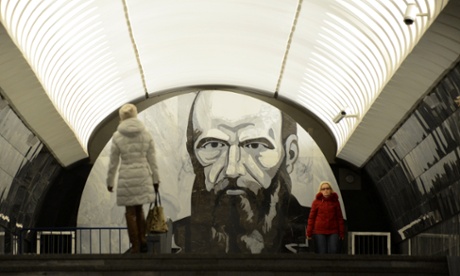
Dostoyevskaya metro station in Moscow, named after the writer Fyodor Dostoyevsky.
Notes from the underground: Dostoyevskaya metro station, named after the writer Fyodor Dostoyevsky. Photograph: Kirill Kudryavtsev/AFP/Getty Images

Selected works

  1. The Lady with a Dog - Anton Chekhov
  2. About Love - Anton Chekhov
  3. The Days of our Lives - Leonid Andreyev
  4. Travels around Crimea - Mikhail Bulgakov
  5. Nose - Nikolai Gogol
  6. Nevsky Prospect - Nikolai Gogol
  7. The Artamonov Business - Maxim Gorky
  8. Mr Prokharchin - Fyodor Dostoyevsky
  9. Egyptian Nights - Alexander Pushkin
  10. Yevgeny Onegin - Alexander Pushkin
  11. Master and Man - Leo Tolstoy
  12. Smoke - Ivan Turgenev

from: Guardian
Posted by Elizabeth at 5:00 PM No comments:
Newer Posts Older Posts Home
Subscribe to: Comments (Atom)

Get Librarians' Group in your Email

Enter your email address:

Delivered by FeedBurner

Search This Blog

Subscribe in a Reader

Subscribe in a reader

Subscribe To Librarians' Group Blog

Posts
Atom
Posts
All Comments
Atom
All Comments

Twitter Feed

Tweets by @LibrariansGroup

Blog Archive

  • ►  2018 (25)
    • ►  June (3)
    • ►  May (3)
    • ►  April (5)
    • ►  March (2)
    • ►  February (7)
    • ►  January (5)
  • ►  2017 (100)
    • ►  December (1)
    • ►  November (18)
    • ►  October (4)
    • ►  September (4)
    • ►  August (12)
    • ►  July (5)
    • ►  June (10)
    • ►  May (7)
    • ►  April (9)
    • ►  March (10)
    • ►  February (8)
    • ►  January (12)
  • ►  2016 (145)
    • ►  December (7)
    • ►  November (11)
    • ►  October (10)
    • ►  September (11)
    • ►  August (10)
    • ►  July (2)
    • ►  June (16)
    • ►  May (26)
    • ►  April (18)
    • ►  March (8)
    • ►  February (15)
    • ►  January (11)
  • ►  2015 (150)
    • ►  December (3)
    • ►  November (15)
    • ►  October (11)
    • ►  September (15)
    • ►  August (21)
    • ►  July (9)
    • ►  June (12)
    • ►  May (15)
    • ►  April (16)
    • ►  March (13)
    • ►  February (10)
    • ►  January (10)
  • ▼  2014 (248)
    • ►  December (20)
    • ▼  November (20)
      • Homeless find hope, refuge and community at public...
      • Bronx library hopes to fill void left after closin...
      • Iceland Reads: The country of 320,000 punches well...
      • Ferguson Library Provides Calm Refuge for a Torn C...
      • Public Libraries: a dying service?
      • Cool Stuff Librarians Do: Librarians Without Borders
      • Say cheese before checking out at Franklin Park li...
      • The Brain on Architecture
      • 5 New Literary Publications to Watch
      • Your brain has a biological response to a good book
      • Moscow Metro's virtual library offers free e-books...
      • Random House Buys innovativeKids Book Line
      • Leading authors mount international open-letter pr...
      • E-Book Mingles Love and Product Placement
      • How Going Electronic Changed Dictionaries
      • Libraries lend a hand to development
      • What Book Should You Read Next? Putting Librarians...
      • Amazon's crowdsourced publishing venture Kindle Sc...
      • Survey: Library Ebook Growth Slowing but Still Sub...
      • Google Play Jazzes Up E-book Nonfiction
    • ►  October (22)
    • ►  September (21)
    • ►  August (20)
    • ►  July (19)
    • ►  June (21)
    • ►  May (21)
    • ►  April (21)
    • ►  March (20)
    • ►  February (21)
    • ►  January (22)
  • ►  2013 (247)
    • ►  December (20)
    • ►  November (17)
    • ►  October (22)
    • ►  September (21)
    • ►  August (19)
    • ►  July (22)
    • ►  June (20)
    • ►  May (22)
    • ►  April (22)
    • ►  March (21)
    • ►  February (20)
    • ►  January (21)
  • ►  2012 (67)
    • ►  December (14)
    • ►  November (22)
    • ►  October (22)
    • ►  September (9)
  • ►  2011 (221)
    • ►  December (1)
    • ►  November (8)
    • ►  October (5)
    • ►  September (12)
    • ►  August (26)
    • ►  July (25)
    • ►  June (26)
    • ►  May (25)
    • ►  April (18)
    • ►  March (26)
    • ►  February (21)
    • ►  January (28)
  • ►  2010 (330)
    • ►  December (20)
    • ►  November (24)
    • ►  October (28)
    • ►  September (29)
    • ►  August (31)
    • ►  July (29)
    • ►  June (25)
    • ►  May (33)
    • ►  April (29)
    • ►  March (31)
    • ►  February (24)
    • ►  January (27)
  • ►  2009 (166)
    • ►  December (26)
    • ►  November (22)
    • ►  October (21)
    • ►  September (20)
    • ►  August (19)
    • ►  July (15)
    • ►  June (8)
    • ►  May (10)
    • ►  April (9)
    • ►  March (9)
    • ►  February (4)
    • ►  January (3)
  • ►  2008 (6)
    • ►  December (2)
    • ►  November (1)
    • ►  October (2)
    • ►  September (1)

Labels

  • 3D printing (12)
  • academic libraries (6)
  • advocacy (14)
  • archives (18)
  • audiobooks (9)
  • authors (24)
  • Awards (25)
  • bibliotherapy (4)
  • book clubs (2)
  • book sales (8)
  • books (67)
  • bookstores (11)
  • budget (29)
  • censorship (18)
  • children (10)
  • children's books (15)
  • collection development (19)
  • customers (25)
  • Decolonization (1)
  • design (13)
  • digital literacy (2)
  • digitizing (4)
  • diversity (4)
  • DVDs (4)
  • e-books (49)
  • e-resources (6)
  • funding (1)
  • gender gap (2)
  • Google (20)
  • history (1)
  • indigenous peoples (3)
  • innovation (2)
  • international libraries (24)
  • internet (25)
  • internet archive (1)
  • LGBTQ (15)
  • Librarians (34)
  • libraries (113)
  • library (6)
  • library employment (9)
  • library problems (28)
  • literacy (8)
  • magazines (3)
  • makerspaces (7)
  • marketing (15)
  • mental health (1)
  • Mississauga (8)
  • Mystery (4)
  • newcomers (4)
  • nonfiction (4)
  • Privacy (7)
  • private libraries (2)
  • programming (13)
  • public libraries (123)
  • publishing (16)
  • readers' advisory (6)
  • reading (35)
  • reference (2)
  • school libraries (10)
  • social issues (66)
  • social media (16)
  • special libraries (2)
  • staff (6)
  • STEAM (6)
  • Technology (21)
  • trends (7)
  • unusual libraries (27)
  • volunteers (6)
  • weeding (2)
  • Wikipedia (3)
  • words (2)
  • YA Fiction (7)
  • youth (18)

Contributors

  • Ambreen
  • Cate
  • ElizabethM
  • Fiona
  • Unknown
  • Unknown

Followers

Simple theme. Powered by Blogger.